The chances are good that SEO will undergo fundamental changes in 2026: Visibility will no longer be determined solely by classic ranking factors such as keywords and backlinks, but by a complex interplay of technology, user needs, content quality, and brand trust. In this article, we highlight the most important developments that will shape your SEO strategy in 2026 — from AI-powered search and new forms of content optimization to changed KPIs and user experience.
SEO Trends 2026 Source: eology GmbH
From classic ranking to generative search
With the advent of large language models and AI-powered search systems, SEO is evolving toward Generative Engine Optimization (GEO). Content is increasingly being evaluated not only in the traditional way—i.e., by ranking it in lists—but also based on whether it is cited as a trustworthy source in generated responses.
GEO focuses on semantic depth, context, and authority rather than just keywords.
Content should be “scannable” for machines—with a clear structure, understandable context, and high-quality sources.
A strong domain with a good reputation has advantages, as generative search services often favor content that is perceived as trustworthy.
This means that SEO will not become less technical, but more strategic and “intelligent.” By 2026, the task will no longer be just to be found, but to be perceived as an authoritative source.
Key SEO trends for 2026
#Trend 1: Disciplined SEO strategy: balance between short-term, long-term, and basic
The article SearchEngineLand emphasizes that strategic discipline will be crucial in 2026: Successful SEO strategies combine short-term successes, future-oriented investments, and regular maintenance of the foundation.
Short-term measures (e.g., technical fixes, structured data, minor content optimizations) create visible progress—important for internal stakeholders and budget approvals.
Long-term investments (e.g., topic clusters, domain authority, content ecosystems) ensure sustainable visibility. And continuous “business as usual” keeps performance stable and protects against ranking losses.
A structured SEO strategy with clear prioritization and recurring SEO routines is a basic requirement. Without discipline, there is a risk of getting stuck in innovation hype or falling permanently behind.
#Trend 2: Dominance of AI search systems & generative engine optimization
According to the Search Engine Journal report, many SEO teams plan to integrate AI into their workflows on a massive scale — 58% are relying on a combination of human expertise and AI support.
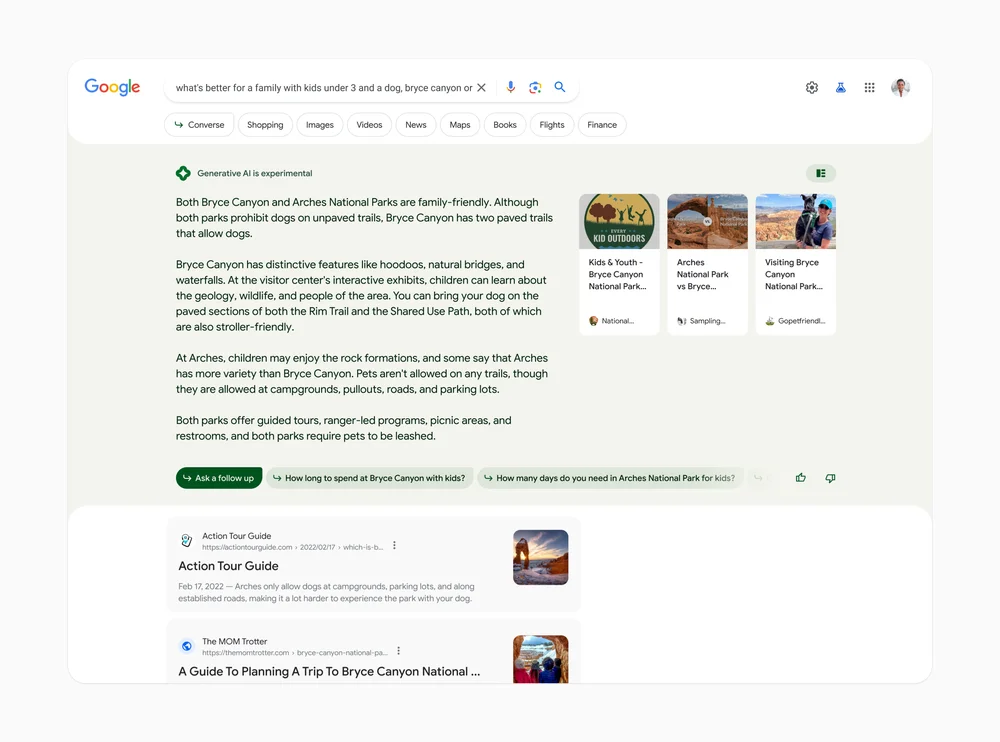
The trend is toward Google SGE /AI Overviews and generative response formats: Content must be designed in such a way that it is recognized as a quotable source for AI responses — not just for classic rankings.
In practice, this means that content must be structured in a way that is understandable to machines, semantically rich, and credible in terms of content, with supporting evidence (e.g., via sources, data, clear authority).
SEO 2026 requires more than traditional keyword optimization — design your content so that AI search engines use it as a reliable source of answers. GEO will thus become an integral part of any future-oriented strategy.
#Trend 3: Topic clusters, semantic depth, and topical authority over individual keywords
More and more voices are emphasizing that individual pages optimized for keywords are no longer sufficient. Instead, topic clusters (content hubs), semantic context, and comprehensive treatment of a topic are crucial.
This approach creates topical authority—meaning that a domain is perceived as a serious expert resource on a specific topic. This is a significant advantage, especially in an environment with generative search.
Internal linking within clusters, clear logic, and user guidance (e.g., FAQs, related sections, structured content) are important elements here.
Avoid content that only exists “because Google wants to see it.” Content should not be based on keyword lists, but on what your target audience really wants and expects.
A sustainable content strategy functions like an ecosystem—with thematic focal points and a clear structure, rather than a collection of isolated pages. Build topic clusters instead of individual articles, link relevant content internally in a meaningful way, and strengthen the authority of your authors through transparent biographies, case studies, and verified sources.
#Trend 4: Holistic visibility: multimodality, new channels, and reach beyond traditional search results
The focus is shifting beyond traditional search engines: today, content must also be optimized for video, images, audio, voice search and app/smart device search systems.
The term “search experience optimization” is becoming increasingly important: user experience, performance, usability, and cross-channel visibility are merging with traditional SEO.
Want to stay visible in the future? Make your content flexible, versatile, and cross-channel—no longer just on websites, but also on platforms, in media, and in AI responses.
#Trend 5: Trustworthiness, quality, and authority (E-E-A-T & brand signals)
Die Reputation eines Webauftritts — also Expertise, Glaubwürdigkeit, Transparenz — gewinnt an Bedeutung, vor allem mit der Verbreitung von KI‑Suchsystemen. Inhalte mit belegbaren Quellen, klar gekennzeichneten Autoren oder Daten schaffen Vertrauen.
Der Bericht von SEJ zeigt, dass viele SEO‑Teams bewusst auf Qualität statt Quantität setzen: Zwar ist der Aufwand hoch, aber originaler, gut recherchierter Content gilt als „Secret Weapon“.
Für Google & Co. dürften künftig neben Links und klassischen SEO‑Signalen auch Marken‑ und Entitätssignale relevanter werden — also Signale, die zeigen: Deine Website ist vertrauenswürdig, seriös und thematisch relevant.
Visibility in AI, SERPs, and social media is not a coincidence, but the result of strategic brand management. We’ll show you what measures you can take to remain visible and relevant in AI-supported search environments:
Use structured data: Consistently use schema markup to prepare your content in a way that AI systems can understand. This facilitates machine classification and improves visibility.
Create clear content: Formulate answers directly, confidently, and with technical expertise—in a way that can be reproduced in generated search results.
Deliver quotable content: Incorporate original studies, current statistics, industry insights, or expert statements into your content. This increases the chance that AI services will include your content as a trustworthy source.
#Trend 6: New metrics & KPIs — beyond clicks and rankings
In an environment with zero-click searches (e.g., AI responses, direct answers without clicks), the metrics used to measure success are changing. The focus is shifting from pure click numbers to brand queries, mentions, returning visitors, and conversions.
According to SEJ, SEO teams are observing that content creation and authority building are more time-consuming, but deliver the best ROI.
Related to this, the performance of an SEO strategy must increasingly be evaluated holistically: reach, added value, engagement, and credibility count at least as much as classic ranking positions.
Strengthen your brand with consistent messaging and revise old content to provide precise answers to frequently asked questions. This will increase your visibility in zero-click searches. You should also rethink and adjust your KPI sets—moving away from pure SEO metrics toward measurable valuable visibility and user engagement.
#Trend 7: Technology, architecture, and a solid foundation remain indispensable
Even though the focus is shifting more toward content, AI search systems, and user experiences, technical fundamentals remain important: loading times, mobile performance, clean HTML, structured data, crawlability, and site structure.
Especially with regard to GEO, semantic structure, clean markup, and clear identification of entities (people, brands, places…) are important so that AI systems can correctly capture and assign content.
Technical SEO remains the cornerstone of any sustainable strategy — content and distribution need a stable technical foundation.
Why these trends remain relevant and how sustainable they are
Current developments in search engine optimization are not short-term fads, but reflect profound structural changes in digital information behavior. Classic SEO remains important, but it is being expanded by new requirements. Visibility is increasingly created through the interplay of technical excellence, user-centered content, and trustworthy brand communication.
AI-based search systems such as Google’s AI Overviews or SearchGPT in particular show that simple optimization is no longer sufficient. A clear strategy is needed to be considered a reliable source in AI responses. This includes understanding and targeted application of LLMO (Large Language Model Optimization): Content must be formulated and structured in such a way that it can be recognized by language models, correctly classified, and cited in the generated responses.
Those who implement these principles early on will ensure long-term visibility—not only on the traditional web, but also in the increasingly important AI-based discovery systems. This makes SEO a sustainable component of holistic brand management.
SEO trends 2025: an overview of the most important developments
Search engine optimisation (SEO) is constantly evolving. For 2025, several significant trends are emerging that companies and marketers should consider in order to strengthen their online presence. Some trends from last year, such as voice search, high-quality content or AI, will continue to be relevant next year. The following is a detailed presentation of the key SEO trends for 2025 to provide you with a comprehensive orientation.
1. Artificial intelligence (AI) and machine learning
The rapid development of artificial intelligence in recent years has also significantly changed the way search engines work. Google and other search engines are already using complex AI algorithms to better understand users’ search intent and provide them with customised results. One prominent example of this is Google SGE (Search Generative Experience), which uses artificial intelligence to provide generated answers and contextual information directly in the search results. Rather than directing users to different websites, Google SGE delivers precise, intent-matching answers, significantly improving the search experience. This trend is expected to intensify in 2025.
It is no longer just about classic optimisation for keywords. Rather, it will be crucial to understand the underlying context and intention behind search queries. Content that is geared exclusively to keywords will increasingly lose its importance. Instead, personalised and dynamic content that optimally addresses user needs will become more relevant.
The integration of AI into SEO, as driven by Google SGE, also means that machine learning will play an increasingly central role. Algorithms that continuously evolve and adapt to changing user habits require SEO strategies to be continually adapted.
The Sonata Insights study looked at the question of what is changing as a result of AI search. We have summarised the findings in our eo:news. 🙌🏼🤖
How will SearchGPT change traditional search?
SearchGPT has the potential to fundamentally change traditional search and search engine optimisation (SEO). Traditional search engines are primarily based on keyword and link matching to deliver search results. However, SearchGPT goes one step further by understanding the intent behind users‘ searches and contextually tailoring content much more precisely. By using artificial intelligence and advanced machine learning, SearchGPT can not only display relevant results but also dynamically customise them to users’ individual needs and preferences.
For SEO, this could mean that focusing on purely keyword-based strategies will be less effective. Instead, companies need to create content that offers a deeper context and directly addresses the searcher’s intention. Content tailored to the user experience and needs will become increasingly important in the future. At the same time, the integration of AI and machine learning requires continuous adaptation of SEO strategies, as algorithms like SearchGPT are constantly learning and adapting to new user behaviour.
2. Voice Search and Natural Language Processing
The increasing popularity of voice assistants such as Alexa, Siri and Google Assistant has significantly changed the way users search for information. Voice search requires content to be adapted to use natural language and conversational phrases. Long-tail keywords are becoming more important because voice searches often consist of more detailed, conversational phrases. To succeed in voice search, businesses should design content to provide direct and precise answers to typical questions.
Google continues to place a high value on user experience, with Core Web Vitals playing a central role. These metrics include a website’s loading speed, interactivity and visual stability. Technically optimised websites that ensure smooth navigation and fast loading times not only have a better chance of ranking highly, but also increase the time spent and engagement of users. A positive user experience is thus not only a ranking factor, but a decisive competitive factor in the digital world.
Technical SEO also remains a central basis for successful online marketing. Optimisations such as structured data, schema markups and a mobile user experience not only contribute to better rankings, but also ensure barrier-free and pleasant use. A clear page structure, intuitive navigation and fast loading times are just as essential as taking security standards such as HTTPS into account.
4. zero-click searches and featured snippets
Zero-click searches, where users get the information they are looking for directly on the search results page, are becoming more and more common. To benefit from this trend, content must be structured in such a way that it can appear as a featured snippet. Clear and concise answers to frequently asked questions, the use of tables, lists and other structured formats help to optimise content for this prominent position in search results. This ensures that your website remains visible even in an increasingly competitive environment.
Visual content such as videos and images continues to grow in importance. Platforms like YouTube, TikTok and Instagram have shown that video content can significantly increase time on site and click-through rates. Companies should make more use of video content and optimise it for search engines by integrating relevant keywords into titles and descriptions. Visual search, in which users use images as a starting point for a search, is also continuing to grow in importance. Optimised image files with meaningful filenames and alt tags are therefore essential to succeed in visual search.
The importance of high-quality content that radiates experience, expertise, authority and trustworthiness continues to grow. Content should aim to meet specific questions and needs of the target group. A well-founded target group analysis helps to create content that offers real added value and builds long-term trust.
Google continues to place a high value on content created by experts and supported by references and links that substantiate its authority. Transparency is crucial here: information about the authors and their qualifications can significantly increase users’ trust in the content provided.
7. Personalisation and local search
Search engines are increasingly personalising search results based on user preferences and location. For businesses, this means that optimisation for local searches will remain essential next year. Maintaining a Google My Business profile, consistent name-address-phone number (NAP) data and the use of local keywords are crucial to remaining visible in local searches. Local search offers enormous potential, especially for small and medium-sized businesses.
8. data protection and SEO: avoiding legal risks
With stricter data protection laws such as the GDPR, companies must ensure that their SEO strategies are compliant with data protection regulations. Transparent data protection guidelines and obtaining user consent are just as important as using privacy-friendly tools. Striking a balance between effective data analysis and protecting user privacy will be one of the key challenges for marketers.
9. Professional link building
Backlinks remain an important ranking factor, but the quality of these links is more crucial than ever. Google values links from trustworthy and topic-relevant sources higher, which is why companies should focus on building relationships with industry experts and creating high-quality content. Guest posts and partnerships with renowned platforms can help to sustainably increase the authority and visibility of a website.
Find out how link building has changed over the years in our eo:news! 🔗
Final thoughts
The SEO trends for 2025 show that user needs and technical developments are increasingly going hand in hand. Companies that remain flexible and incorporate these trends into their strategies at an early stage will be able to sustainably strengthen their visibility and relevance in the digital space. Search engine optimisation is not a static field, but a continuous challenge that requires innovation and adaptability.
These SEO trends should be on your radar in 2024!
The trends in search engine optimisation (SEO) for 2024 show a strong focus on the integration of artificial intelligence (AI) and adjustments to the way Google crawls and indexes websites.
1. Use of AI in SEO and marketing
AI technologies are increasingly integrated into SEO and marketing workflows. In 2024, this integration is expected to become even more sophisticated. In particular, tools for creating AI-generated text and images, as well as AI-supported meta tag generators, will play an important role. These tools make it possible to expand SEO capabilities and use them more efficiently.
2. Voice search
With the increase in the use of voice assistants such as Amazon Alexa and Google Assistant, voice search will continue to grow in importance in 2024. Content should be optimised for voice search queries.
3. Mobile-first indexing
As more and more people search from mobile devices, optimising websites for mobile devices is essential and will remain an important topic in 2024.
4. User experience and Core Web Vitals
A good user experience, measured using Google’s Core Web Vitals, is crucial for a good ranking. Websites should load quickly, be user-friendly and offer high-quality content.
5. Focus on thematic authority
It is increasingly important to be considered a reliable source of information for specific topics or niches. Search engines, especially Google, prioritise content that demonstrates authority, defined as a combination of experience, expertise, authority and trustworthiness (E-E-A-T).
6. Video SEO
There is a huge opportunity in creating video content that ranks in both Google search results and on YouTube. It is expected that the number of digital video viewers worldwide will reach almost 3.5 billion by the end of 2023. A solid video SEO strategy is therefore crucial.
7. Evolving search engine ranking factors
Search engine ranking factors continue to evolve to prioritise trustworthy and knowledgeable content that immediately delivers the best answer to users’ queries. Google assesses the user-friendliness of web pages via metrics such as page load time and interactivity. Good UX is increasingly important for ranking. Leading SEO factors for search rankings include machine learning/AI, Core Web Vitals, and E-A-T & Trusted Sources.
8. Local search engine optimisation
Local searches have increased, underlining the importance of local SEO. Companies should strengthen their presence in local directories and on platforms such as Google Maps.
9. Featured snippets
These provide an excellent opportunity to be showcased directly in Google search results. Content should be designed to appear as answers to user questions in featured snippets.
10. Sustainability and security
Search engines are expected to favour websites that are environmentally friendly and adhere to strict security standards in the future.
11. Shopping opportunities
In view of the growing e-commerce market, online retailers should strengthen their presence on search engine platforms. This could increase the importance of optimising for e-commerce platforms.
12. Update and refresh content
To keep up with ever-changing algorithms, it is important to regularly update and refresh content.
13. Social SEO
With platforms like TikTok, the SEO landscape is changing. It is becoming more important to optimise content for social search engines.
These trends show that SEO in 2024 will be highly dynamic and heavily influenced by technological advances, particularly AI. The ability to adapt to these developments and to use new tools effectively will be crucial to success in SEO.
SEO Trends 2021
In a nutshell, Google Page Experience metrics will go live with Core Web Vitals in May 2021, among other things. For us, this means user experience and satisfaction will be given an even higher priority and introduced as major ranking factors. But there’s more in store for us in the coming year – here come the SEO Trends 2021!
First things first: Google Page Experience
Core Web Vitals are an important part of the new Page Experience metrics. These are primarily there to identify user-unfriendly websites. Certainly, Google is currently already strongly behind the idea of better evaluating these pages. But with the Core Web Vitals, this all should be made measurable for webmasters, so that they can more easily find optimization approaches. Additionally, Google has published special FAQs about it.
What else awaits you:
Mobile Only
In the new year, Google is also fully committed to mobile websites. For years, the search engine has been working towards this point and next year it will be time: Google wants to rank mobile optimized websites better in the future. The search engine implements this by having only a smartphone crawler index the pages. Thus, desktop-only websites are clearly at a disadvantage, since the crawler ignores them completely. For this reason, you should definitely prepare your pages for the mobile-first conversion.
HTTPS and secure internet usage
Security is very important to Google! For this reason, the search engine wants to remove potentially harmful websites from the search results. This includes, for example, websites that contain malicious or misleading content (e.g. in the form of spyware or malware). These harmful sites are then banned from the top search results.
In addition, secure websites with an SSL (Secure Sockets Layer) certificate are clearly preferred by Google. There, user data is better protected against hacker attacks. Therefore, you should switch to HTTPS next year at the latest in order to continue to achieve positive ranking results.
No intrusive interstitials
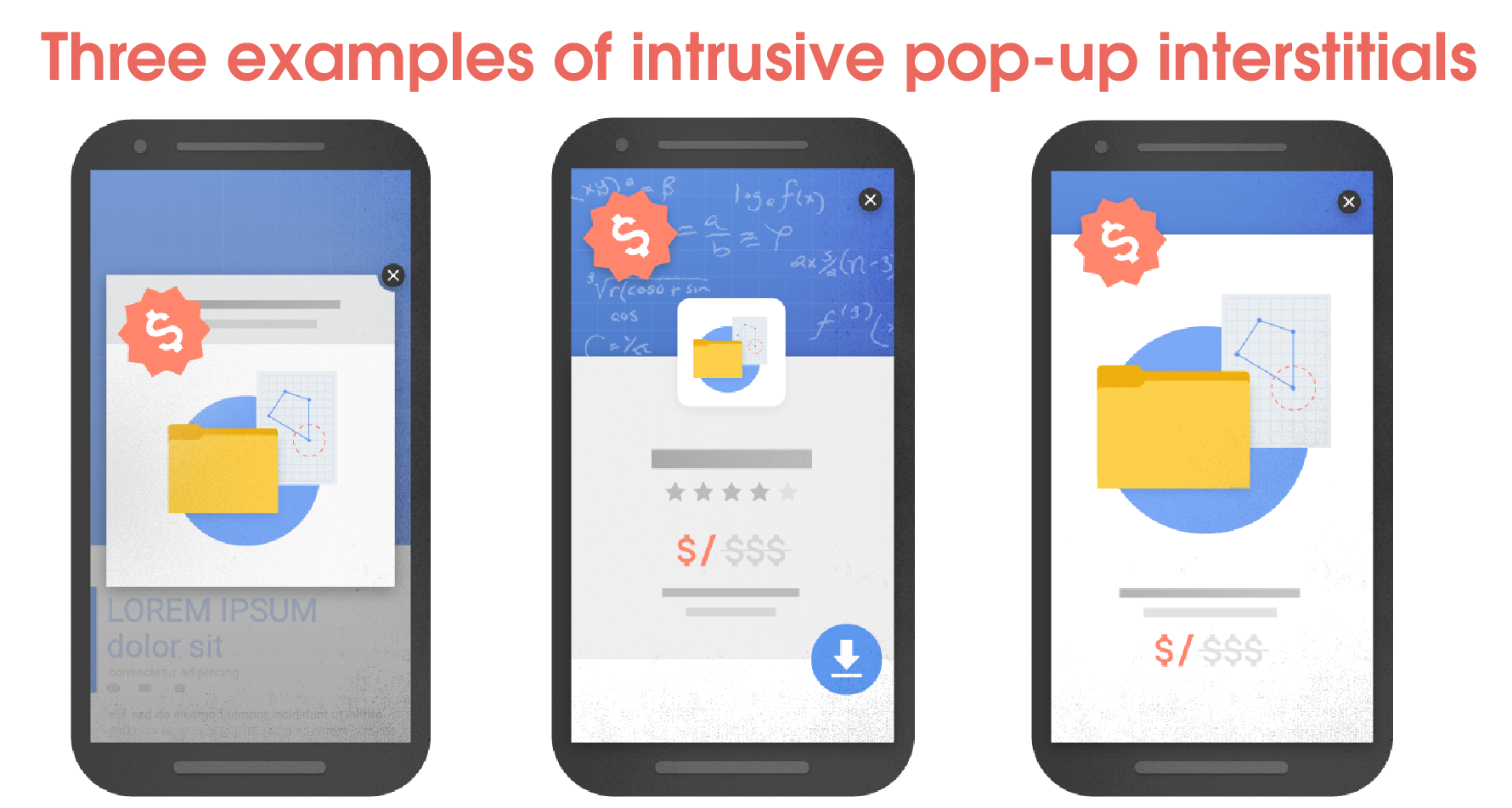
Interstitials are advertising banners that interrupt a user’s visit to the website in order to generate more attention. If you use these and thus ensure that users can no longer access the desired content, this will also be penalized more in the future. Pop-ups are often the main culprit in these cases, as they pop up regularly and users often find it difficult to close them again.
Three examples of interstitials that impede or prevent easy access to content, source: Google Search Central-Blog
Javascript, load times, WebP and Co. will again be an important topic in the coming year. So, if you’re not yet that knowledgeable in these areas, you should urgently catch up. If you have the insight, this will help you to improve your rankings. Here are some points that could be important for you in this train:
Delete unused code
Activate your cache
Create sitemaps
Optimize scripts and CSS files
Accessibility
Clickability of links, contrast, text size, etc. – these are all important points to make a page accessible. This in turn is necessary if you want to create a user-friendly website. Usability will also be a hugely important factor for Google in the coming year, so you should be prepared for it.
Indirect: Social Signals
It’s hard to imagine social networks without shares and likes. Even though Google regularly emphasizes that social signals are not and will not be ranking factors, they can have an indirect influence on your findability in search engines. The reason behind it: If your social content is liked and shared a lot, you will be perceived as an expert. And this expert status does not escape Google. So, it is worthwhile to publish content that interests your target group in social networks as well.
Voice Search
Alexa, Siri and others are making voice search more and more prominent. For some generations, it has become quite normal to simply ask a voice assistant a question instead of having to enter it into Google Search. Even though preparing for voice search is very time-consuming, you should check your optimization potential here. This method can offer your users a great deal of added value and consequently help you to achieve more conversions. Therefore, it is important to prepare information for voice search as well, if this makes sense for your industry and your products.
Virtual und Augmented Reality
Google has been working on integrating augmented reality into search for a while now. If you search via the app on your smartphone, you can even bring animals to your home via AR.
This technology is particularly suitable for product presentation, which is why you should consider whether it might be worthwhile for you to rely on AR or VR.
The perennial favorite: Content
Semantics is an important issue that will be with us all even more in 2021. Google is working more and more towards understanding texts in the right context. In order to achieve this, you can also locate relevance-increasing keywords during a keyword research via WDF*IDF tools. It is also important to compare your texts with the competition. This can be done, for example, using the tool Termlabs.io, but this alone does not guarantee top rankings! A good copywriter is the key to conjuring up great content from keyword research. Content by people for people – machine-generated content has long had its day! The overall presentation of the content is also becoming increasingly important, as this sends good user signals to the search engine. Proper editing therefore helps you here.
In addition, it is important that you pay attention to the search intentions of your users. Only if you answer them, your content is relevant for search queries and appears in the SERPs. You should also proceed according to theE-A-T principle. E-A-T stands for Expertise (credibility), Authority (authority) and Trustworthyness (trust). These criteria will help you stand out from your competitors.
Last but not least, regular content hygiene is very important. Update your texts and media regularly so that they are always up to date. This sends good signals to the search engine. You should also delete bad or outdated content! This way you get a slimmed down and targeted website.
Video content as a chance for good rankings
YouTube is being promoted more and more by Google. In fact, it is the most visible page within the search engine – even ahead of Facebook and Wikipedia! Therefore, the platform can be an effective way to gain reach and deliver value to your users. Videos are often referred to as “snackable content” because they are something that users can pick up quickly. This allows you to present more complex topics in a way that’s easy to understand. Also cool: You can even achieve positive rankings via videos.
Longtail SEO
Another opportunity are long-tail keywords to cover zero-click searches. The problem with zero-click searches is that answers are already given in the SERPs and therefore no further pages are clicked on by the users. In this case, you can serve more complex search queries via long-tail keywords. Thanks to the BERT update, Google also understands this type of keywords better and thus provides you with correspondingly better rankings.
How to optimize your site for 2021
Of course, the Page Experience metric does not replace the existing ranking factors. Rather, it serves as a supplement to the whole. A continuously important factor is the quality of your content. The following five tips will get your site ready for the new year:
Choosing your web hosting service: This can be critical to how quickly your site responds.
Size of your site: Make sure that e.g. images are optimized to not unnecessarily inflate the size of your site. You can also minimize JavaScript or CSS. Unnecessarily large files otherwise worsen the PageSpeed of the page.
Mobile optimization of the website: From 2021, pages will only be crawled with a smartphone crawler. Mobile optimization is therefore inevitable.
Security guarantee: If your site does not yet have an SSL certificate to encrypt data, you should definitely upgrade in 2021.
Reduce or remove interstitials: Don’t place huge banner ads on your site that interfere with users interacting with it. Use more subtle advertising. This makes the user happy and Google happy too.
In a nutshell: These are the trends at a glance
Trends at a glance
Author
Olga FedukovMarketing Manager
Olga Fedukov completed her studies in Media Management at the University of Applied Sciences Würzburg. In eology's marketing team, she is responsible for the comprehensive promotion of the agency across various channels. Furthermore, she takes charge of planning and coordinating the content section on the website as well as eology's webinars.
ChatGPT & AI chatbots are changing search behavior! While Google continues to dominate, traffic via AI is growing rapidly. Studies show that AI-supported queries are longer and more interactive. Learn more about the differences, effects on link building and off-page SEO, and how they can benefit your SEO strategy! ... Continue readingChatGPT and AI chatbots: influence on search behavior and web traffic
For almost a year and a half, the issue of cookieless tracking has hovered like a sword of Damocles over the heads of advertisers and web publishers. Preparations for the end of third-party cookies are burning hot. But now Google is rowing back: the cookie phase-out is being postponed until mid-2023! This was originally scheduled for the end of 2022. ... Continue readingGoogle: No cookie phase-out for the time being?
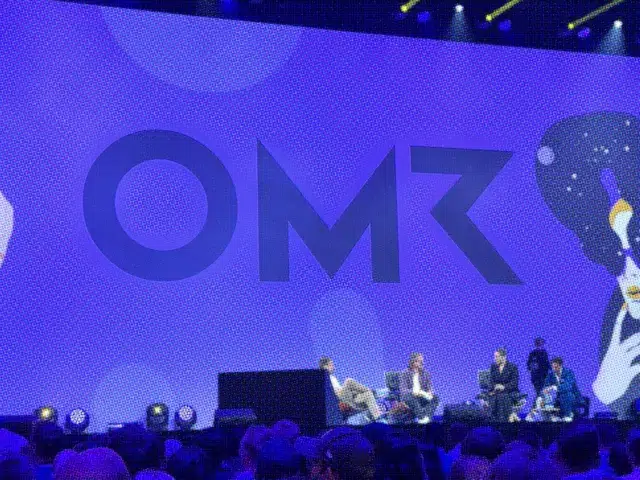
Two days in Hamburg, hundreds of conversations, and one topic that’s on everyone’s mind: AI Visibility. eology was at OMR 2026 with its own booth and four experts, and saw just how urgently companies are currently seeking answers to the question: Is my brand visible where AI provides answers? ... Continue readingeology at OMR 2026: AI Visibility is transforming the industry
03 min
Want to know how your brand will appear in AI searches?
You are currently viewing a placeholder content from Hubspot Embedded Content. To access the actual content, click the button below. Please note that doing so will share data with third-party providers.
You are currently viewing a placeholder content from HubSpot. To access the actual content, click the button below. Please note that doing so will share data with third-party providers.
You are currently viewing a placeholder content from Hubspot Meetings. To access the actual content, click the button below. Please note that doing so will share data with third-party providers.