


Angular
Angular is a powerful framework for the development of single-page web applications (SPAs). Learn more about this here. ... Continue readingAngular

The term Above the Fold originated in the print sector. Fold means fold in German. It therefore refers to everything that can be found above the fold of the newspaper. This means that the content is visible in the part of the newspaper that is visible to the reader without folding it up. Applied to the Internet, above-the-fold content is content that users see first without having to scroll further or click deeper into the website. They thus receive this information at a glance. For this reason, Above the Fold content should always show the most relevant part to arouse the reader’s curiosity. You should therefore clearly consider the structure and the content that you play out directly here.
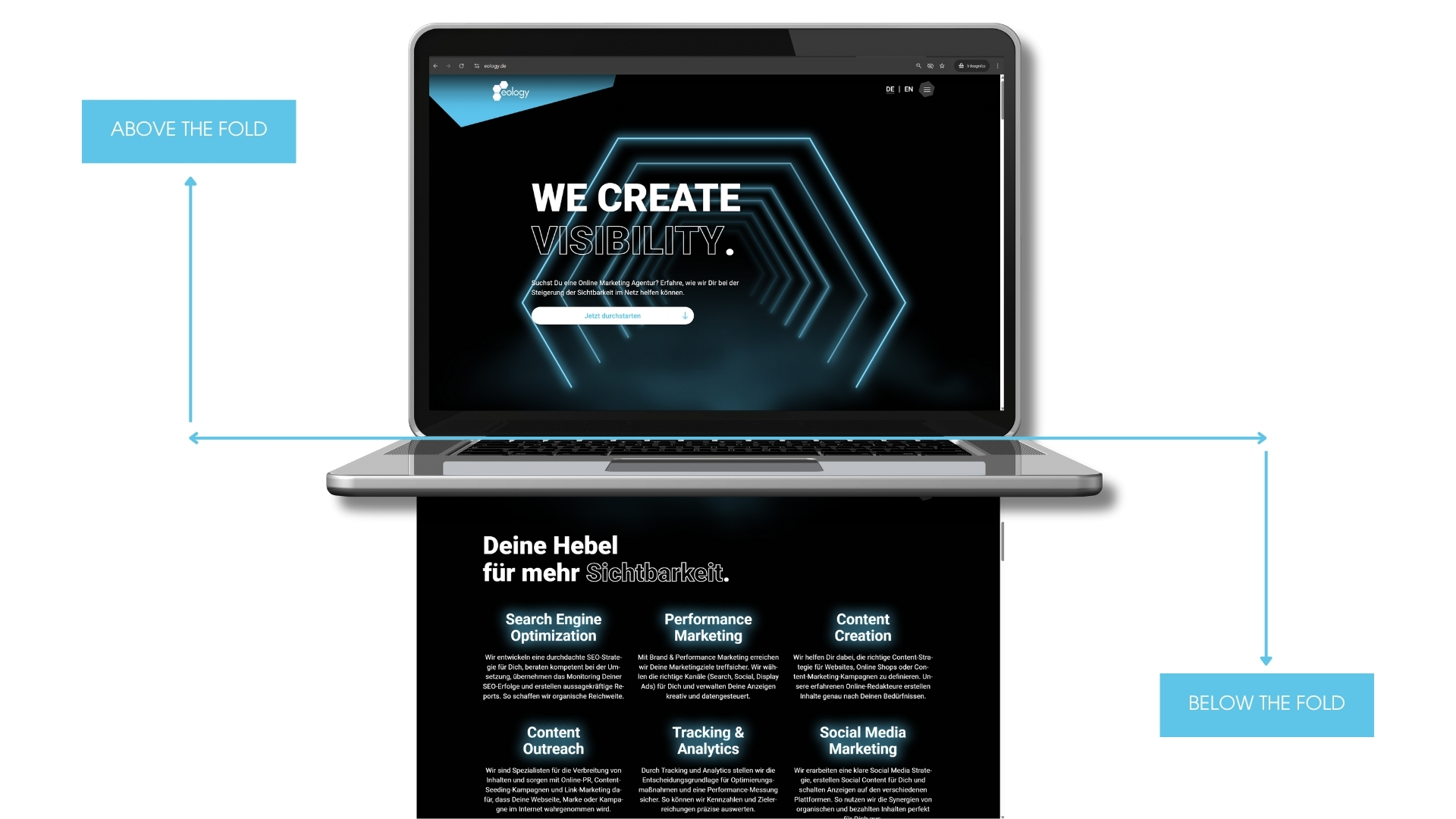
The start screen of the website should therefore also contain images or texts that are only fully visible to the surfer when he actively scrolls. This can be done, for example, with teasers, overlapping text content or arrows.
A precise analysis of your users’ behavior also helps you to optimize the above-the-fold content. For example, you can use the scroll depth or the bounce rate to find out how far your users found the content interesting. You also get more information about how your website visitors interact with your page.
Now, of course, the question is which area can be seen at all without scrolling. Normally, the designer of a website defines which area is visible on which end device. This is determined by the pixel specification.
The following options are available:
The above the fold area plays a central role in search engine optimisation, as it shapes the first impression of a page – both for users and for Google. Content that is immediately visible has a significant impact on the user experience and can therefore also influence the ranking positively or negatively.
Since the Google update to the Page Layout Algorithm (2012), the algorithm has been evaluating pages more critically if they place an excessive number of advertisements in the visible area. Such a design is perceived as distracting and can lead to ranking losses.
For effective above-the-fold optimisation, the focus should therefore be on high-quality content such as concise headlines, relevant keywords and clear calls to action (CTAs). A balanced ratio between user-oriented content and advertisements is crucial for strong performance in search results.
In the past, it was immensely important to pack the website as full as possible to give the website visitor as much input as possible. But that has changed in the meantime. Nowadays, many users are on the Internet with their cell phones. Accordingly, their surfing behavior has also changed.
You probably know it from yourself: The page is loaded quickly and you are scrolling even faster to find what you are looking for. It’s also very easy to change the screen view – a quick swipe takes you somewhere else in no time. Therefore, the question arises whether the directly visible area of a website is still important or has the same relevance as before.
The answer to that is a resounding yes! Above the Fold is still very important. This is due to the growing impatience of users. Information on questions should be found faster and easier. Therefore, it is more important than ever that you provide concrete answers at first glance. You therefore need to rethink the design of your content and your website and also the right structure of it.
Since Google uses the mobile-first index, the algorithm primarily evaluates the mobile version of a website. Therefore, pay particular attention to ensuring that the above-the-fold area on smartphones is clearly structured, loads quickly and is user-friendly. Outdated content or desktop-centric layouts can have a negative impact on visibility.
Above the fold content still brings almost 80% of the attention to a website. That’s why it’s immensely important to capture the reader’s attention in this area of the website and keep them engaged. Because once the attention is aroused, he will automatically scroll to find more interesting content. At best, you also encourage the user to click through your website.
Olga Fedukov completed her studies in Media Management at the University of Applied Sciences Würzburg. In eology's marketing team, she is responsible for the comprehensive promotion of the agency across various channels. Furthermore, she takes charge of planning and coordinating the content section on the website as well as eology's webinars.
Angular is a powerful framework for the development of single-page web applications (SPAs). Learn more about this here. ... Continue readingAngular
ChatGPT ist ein hochentwickeltes Sprachmodell, das von OpenAI entwickelt wurde. Es basiert auf der GPT (Generative Pre-trained Transformer) Architektur, die darauf abzielt, menschenähnliche Texte zu generieren. Erfahre hier mehr über ChatGPT und die Versionen des Sprachmodells. ... Continue readingChatGPT
Snackable content refers to short, easily consumable content that quickly grabs attention and conveys a message immediately. Learn more about it in this article. ... Continue readingSnackable Content
You want to learn more about exciting topics?
You are currently viewing a placeholder content from Hubspot Embedded Content. To access the actual content, click the button below. Please note that doing so will share data with third-party providers.
More InformationYou are currently viewing a placeholder content from HubSpot. To access the actual content, click the button below. Please note that doing so will share data with third-party providers.
You are currently viewing a placeholder content from Hubspot Meetings. To access the actual content, click the button below. Please note that doing so will share data with third-party providers.
More Information


