Shopping Ads – Google and its alternatives in the spotlight
eologyWhitepaperShopping Ads – Google and its alternatives in the spotlight
Request free whitepaper
Download our free whitepaper on “Shopping Ads – Google and its alternatives in the spotlight” now. Our Brand & Performance Team shows you which alternatives to Google Shopping exist and how you can successfully use different Shopping Ads for your business.
Table of Contents
Shopping Campaign Planning
Google Shopping
CSS
Microsoft Advertising
Social Shopping
Get started with Shopping Ads
Our goal is to give you a comprehensive overview of Shopping Ads (Google Shopping, Microsoft, Meta, Pinterest). Through our many years of experience with clients from various industries, we know that there is no one strategy that fits every company and every objective.
In recent years, the shopping process has changed dramatically and, in addition to Google Shopping, social media has played a significant role. With the constant evolution of technologies and online platforms, shopping has evolved from a traditional, physical experience to a digital activity. In the process, social media shopping has become a place to go to find out about products and services, rediscover them, and buy them directly. The ever-increasing use of social networks such as Facebook, Instagram, Pinterest and TikTok allows companies to stand out and be noticed by potential customers with their products and brands. Through targeted advertising, influencer marketing and viral content, companies can reach a wide audience and increase sales of their products. Social media shopping offers benefits not only for advertisers, but also for users. By presenting products in their social environment, they can get inspiration from friends, influencers and others. All it takes is a few clicks to research products, read reviews and get recommendations before making their purchase decision. Linking shopping features to social media platforms allows consumers to buy products directly from their feed without having to leave the platform.
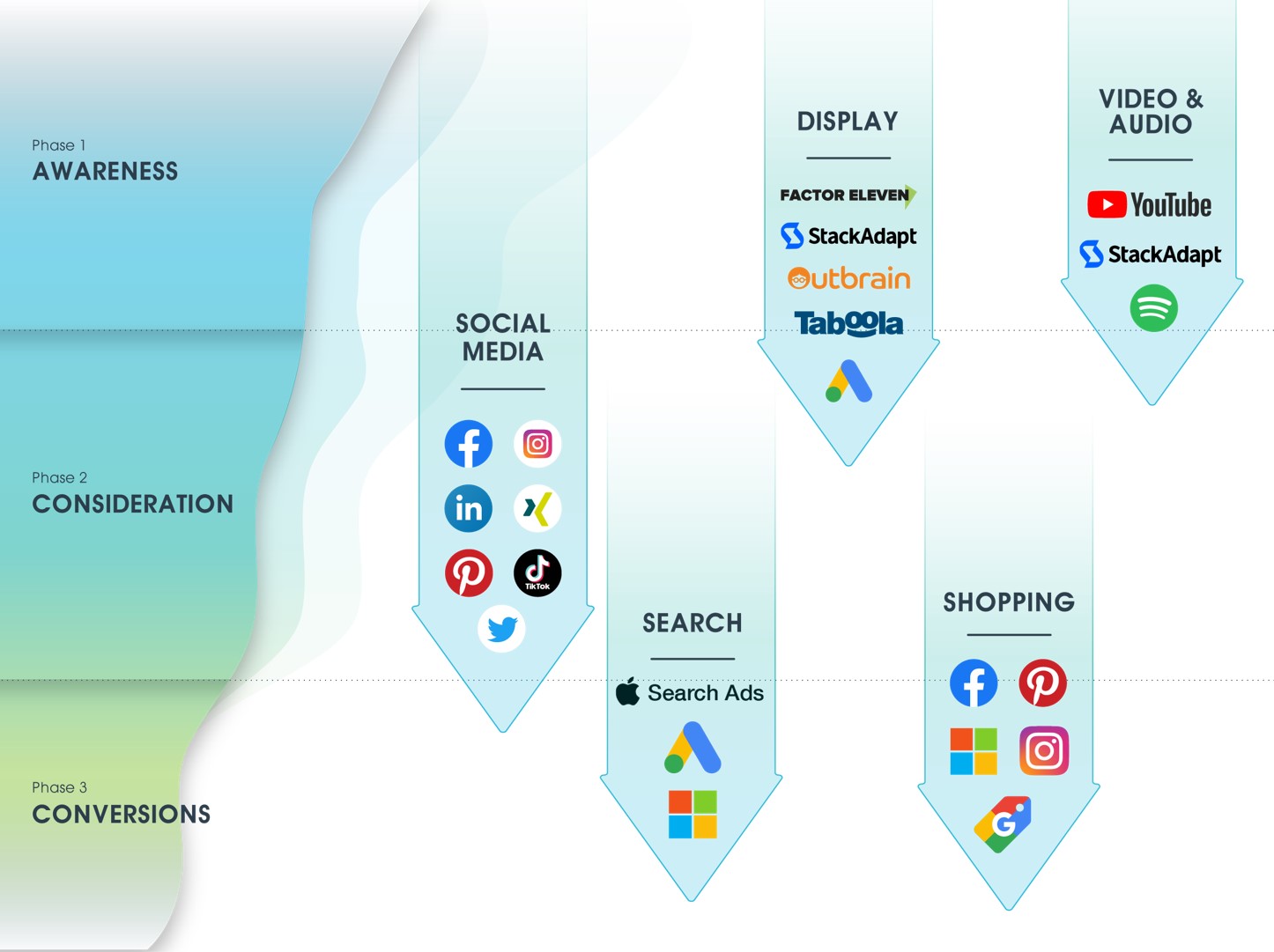
Social media shopping has become a part of modern shopping. Consumers can conveniently and easily shop on their favorite platforms, and businesses get the opportunity to increase their brand awareness and grow their customer base. New features on platforms like Instagram, Facebook and Pinterest are constantly enticing more and more users to buy directly on the platform. Depending on the target group and strategy, different social media channels are suitable for achieving marketing goals.
Figure 1: The Marketing Funnel and its Stages
Shopping Ads in Detail: Answers to the most important questions
What are the requirements for Google Shopping?
For Google Shopping, you need a Google Merchant Center account linked to your Google Ads account, as well as a well-maintained product data feed. In three steps, this means: uploading products to Merchant Center, linking accounts, and creating a campaign, then setting the budget. It’s also important to have accurate product titles with relevant keywords, unique product identifiers such as the GTIN, and proper tracking – for example, via Google Analytics 4. The latter is actually a prerequisite for smart bidding strategies.
What is the difference between Standard Shopping and PMax?
Standard Shopping campaigns run exclusively on Google Search and give you more control, such as the ability to split campaigns between brand and generic terms and analyze individual search terms. Performance Max campaigns, on the other hand, cover the entire Google inventory – including Search, Shopping, YouTube, Display, Discover, Maps, and Gmail – with just one campaign, and manage everything automatically via the algorithm. The trade-off is limited reporting and customization options. Google recommends combining both types.
What is CSSand what are its benefits?
CSS stands for Comparison Shopping Service. Following an EU antitrust ruling, every retailer that lists products on Google Shopping must select a CSS provider. If no active selection is made, everything is handled through Google’s own service, which retains a portion of the cost-per-click. With a CSS partner, however, this budget is fully available to you for the auction, which can significantly lower your effective click prices. Depending on the solution, there are additional benefits such as increased brand visibility in the ads.
Which shopping channel is the right one for my business?
There’s no single “right” channel – the choice depends on your goals and your target audience. If your focus is on direct sales to users who are ready to buy, Google, with its presence in search results, is very close to the moment of purchase. If you want to reach younger audiences or build brand awareness through visual content, Meta and Pinterest are strong options. Microsoft is well-suited as a complementary, often more affordable channel, especially in B2B. It’s recommended that you assess your own needs and test different channels.
Would you like to discuss this with our shopping experts?
In order to use social media shopping, a company must meet certain requirements. As a rule, the first step is to create a business profile on the desired platform. Compared to private profiles, business profiles have additional company-specific functions, such as the integration of shopping functions.
In this whitepaper, we highlight the different SEO challenges faced by site owners and e-commerce decision makers, and show possible solutions that can enable sustainable optimization for long-term success. Download all the info! ... Continue readingSearch Engine Optimization for more Web Traffic
A lot has happened in the year since the publication of the first part of our AI content study.
AI systems have developed rapidly and new models have entered the market. Download the continuation of our study now for free and find out whether AI texts are rankable. ... Continue readingAI Content study part II
Ready to turn product clicks into real sales? Let our SEA experts take your campaigns further.
You are currently viewing a placeholder content from Hubspot Embedded Content. To access the actual content, click the button below. Please note that doing so will share data with third-party providers.
You are currently viewing a placeholder content from HubSpot. To access the actual content, click the button below. Please note that doing so will share data with third-party providers.
You are currently viewing a placeholder content from Hubspot Meetings. To access the actual content, click the button below. Please note that doing so will share data with third-party providers.