Technical SEO: A basic requirement for successful ranking
08 min
eologyeo:magazineTechnical SEO: A basic requirement for successful ranking
Search engine optimization (SEO) is a diverse and complex area of online marketing that has developed significantly in recent years. While the focus used to be mainly on on-page and off-page measures, technical search engine optimization (technical SEO) is becoming increasingly important today. An error-free and optimized technical basis is indispensable in today’s world in order to be successful with search engines. This is because a website that has technical weaknesses will find it difficult to achieve a good position in search results (SERP). Many companies already value a well-thought-out, long-term SEO strategy. However, they forget that it is just as important to do your SEO homework and correct technical errors and warnings sooner rather than later. If the technical SEO basics are in order, the structure of a website can be optimally recognized and understood by search engines. In this magazine article, you will learn which technical aspects you need to pay attention to on your website in order to lay the foundation for good rankings in the long term.
The means to an end: What is a technical SEO audit?
A technical SEO audit is a method of conducting a comprehensive analysis of a website with regard to all technical aspects. The aim is to identify any weaknesses and potential for optimization to ensure that the website is optimized for search engines. Errors in technical implementation can have a significant negative impact on your website’s rankings and performance.
This is how a technical SEO audit works at eology!
The analysis consists of a number of individual steps that must be carried out carefully in order to obtain meaningful results.
It is crucial that the technical examination is comprehensive, as this is the only way to guarantee that no critical errors are overlooked. In order to generate the largest possible database for the technical analysis and to examine all points to be checked efficiently, it is advisable to use various tools such as Screaming Frog, Semrush, SEO plug-ins, the developer console, and many more. Ideally, the technical review should be structured and systematic, following a plan such as an internal technical SEO audit checklist. Once the analysis is complete, it is important to document the results in a transparent and understandable way and to list specific measures for eliminating the problems. This results in two files being created: the action list and the accompanying presentation.
The list of measures plays a particularly central role here, as it serves as a working document that can be used to systematically eliminate the sources of error. The list of measures describes and weights all analyzed errors and affected elements and lists concrete and clear recommendations for action. In addition, the accompanying presentation helps to better visualize the technical errors and clarify the causes and effects for users.
Why is a technical SEO audit worthwhile for your website? Common problems in practice!
Now that you know which technical aspects of your website must be considered, the added value and benefits of a technical SEO audit are beyond question. Nevertheless, it is worth illustrating the whole thing once again with concrete examples. Below, we show you which technical errors are unfortunately all too common in practice and what effects they could have.
Scenario A: Non-indexing of an important page due to incorrect technical settings
1. The meta robots tag
Have you had problems in the past with your pages not being included in the Google index?
This can be attributed to several causes, all of which can be uncovered by a comprehensive technical SEO audit. For example, it may be that the meta robots tag simply contains the wrong value for the “content” attribute.
What exactly does that mean?
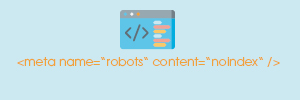
A meta robots tag is an HTML element placed in the head section that provides search engines with instructions on how to crawl a page. In addition to a variety of possible instructions, such as “nofollow,” the meta robots tag can also be used to prevent a page from being indexed. It has the following syntax:
And this is precisely where the error lies. If the “noindex” command is included there, this means that the page in question will not be indexed by search engines and will therefore not appear in search results. With many content management systems and their plug-ins, all it takes is a single incorrectly set check mark in the settings to prevent the content from being found on Google. Mistakes like this can happen quickly. It is not uncommon for months to pass before anyone even notices.
2. Incorrect canonical tag
Another reason why a particular page is not indexed could be that Google considers an incorrect URL as the canonical URL for a particular page on your website.
A canonical tag, also known as rel=canonical, is an HTML tag that, like the meta robots tag, is placed in the head section of the page and used to tell Google and other search engines which URL should be considered the preferred version of a particular landing page. This is helpful in solving the problem of duplicate content. Duplicate content occurs when the same content is offered in different variants on a website, for example, under different URLs or made accessible through parameters. If duplicate content cannot be avoided, it is important to use the canonical tag to clearly signal to Google which page is the original (canonical) and to avoid links within the website to the non-canonical version. Unfortunately, there is no guarantee that Google will ignore the canonical tag. Nevertheless, the correct use of the canonical tag is helpful in ensuring that the right pages are indexed and avoiding penalties for duplicate content, which negatively affect the ranking in search results.
3. Up-to-date sitemap
Another aspect that should be considered as part of the technical SEO audit is the XML sitemap. You should be aware of how your sitemap is generated and whether it is updated at regular intervals, e.g., by a CMS plug-in.
A sitemap should not only be always up to date and complete, but also free of errors. It is not uncommon for Google Search Console to contain an old sitemap that includes 404 pages that no longer exist, redirects, and other errors.
It is important to keep the sitemap up to date and make it accessible to Google, as it is extremely helpful in signaling to Google which pages are important for your website and should be indexed.
Scenario B: The website has poor user experience
Your website can be as beautiful as you like. If users are dissatisfied, potential conversions will not happen!
For years, user-friendliness has been playing an increasingly important role in the evaluation of websites on the Internet. Often, it is technical issues that cause problems that diminish the user experience and can give users negative feelings.
1. 404 errors, missing or unnecessary redirects
A domain can grow quickly. So quickly that it’s easy to lose track of things. If you don’t practice good technical hygiene from the start, more and more legacy issues will accumulate over time.
TIP: A comprehensive technical SEO audit can help!
With the help of a detailed website crawl, all pages, including their status codes, can be identified. A well-known example of this is the so-called 404 error message, which signals that website content has been removed or moved to a different URL and that the page no longer exists on the internet. Unfortunately, in practice, this happens all too often without the internal links being adapted to the new structure.
What happens when users surf your website and, in joyful anticipation, click on a link to a product, blog article, or category page and suddenly land on a 404 error message? In the worst case, the dissatisfied user leaves the website immediately and prefers to look around at the competition.
It would be even worse if the user were not already on the website, but were still searching Google with an open mind to find the information or products they wanted, and a website that no longer exists ranked there. If the website is crawled regularly, 404 pages should ideally not rank at all, but if they do, the consequence would be an immediate click back to Google. What remains is another negative impression of your website!
That’s why it’s very important to avoid 404 pages. You can do this by storing the correct target URL for all internal links and creating a redirect from the old URL to the new target URL. This ensures that both users and crawlers end up at the correct URL thanks to the redirect.
Another example of technical errors in relation to SEO is multiple redirects from an initial URL, known as redirect chains. In contrast to the above example, where the internal redirect is simply missing, the final destination is reached here, but only after detours.
Redirect chains not only use up crawl budget, but also have a negative impact on the loading time of the website. Studies show that each redirect in a chain increases the loading time by 60 to 70 milliseconds, as each redirect link requires an additional server request. Depending on the size of the redirect chain and the capacity of the servers, the loading time of a page can be noticeably slower for the user. This is especially true because the loading time of a website depends on many other factors. A technical SEO audit can help here as well.
2. Loading times and page speed
The topic of page speed plays a central role in the SEO environment. A technical SEO audit reveals sources of error that have a negative impact on the loading time of a website. Why should your SEO strategy also include the topic of page speed?
On the one hand, Core Web Vitals have been an official ranking factor since mid-2021. On the other hand, a slow website speed contributes to a poor user experience. Depending on how much data needs to be loaded from the target URL, it can take several seconds for the visitor to reach their destination. No one is thrilled about waiting a long time to interact with a page. Especially not when the cause is a 10 MB image at the bottom of the webpage. Therefore, you should always be mindful of providing your website online in a resource-efficient manner.
What about the underlying JavaScript and CSS?
Are your images provided in high quality and modern image formats such as WebP in acceptable file sizes?
Are the images loaded via lazy loading only when they actually appear in the user’s field of vision?
These are just a few of the many questions you should ask yourself if you want to make your website faster.
3. Correct implementation of hreflang tags
Another technical aspect you should check is the current status of the hreflang tags on your website. What are they and what role do they play in SEO?
The HTML attribute hreflang tells search engines which language and geographical orientation your page has. If you target international markets and have multilingual pages, you want to ensure that your users always get the most relevant results.
A missing or incorrect implementation of the hreflang attribute can significantly reduce the user experience if, for example, search queries from Italy or Spain lead to the German version of a page, even though the content also exists in the respective language. Since users prefer to consume content in their own native language, it is not unlikely in this example that users will immediately leave the site. Potential conversions are lost.
In this magazine article, you have learned that from an SEO perspective, it is not enough to simply develop a long-term marketing strategy. Rather, a holistic approach is required. In addition to on-page and off-page optimization, you must also consider the technical aspects of your website if you want to achieve lasting success and rankings on the internet. The critical scenarios described above, which have a significantly negative effect, are unfortunately increasingly common in practice and represent only a fraction of what can be implemented incorrectly on your website from a technical perspective. A major problem here is that these critical errors are often given too little attention and many website operators are not even aware of the optimization potential. As briefly mentioned above, professional tools can help here. Tool-supported analyses are not only a fundamental part of performing a technical SEO audit, but are also ideal for the subsequent monitoring of the technical aspects of your website.
Thanks to automated regular crawls or alert functions, anomalies and errors do not remain hidden for long and can be eliminated at an early stage.
How do you handle your technical SEO? Do you already have your website under control in terms of technical criteria, or are you planning a technical SEO audit for the future? We are happy to answer all your questions about SEO.
Author
Christian EberhardtSEO & AI Search Expert
Ebi studied Business Informatics at the universities of Würzburg and Passau. As an SEO & AI search expert at eology, he uses his expertise in data science and machine learning to evaluate new developments, tools and efficiency enhancements in the field of artificial intelligence and to help companies increase their organic reach with the help of individual strategies.
To avoid duplicate content and to tell the search engine bots in which language your website is and for which region it is intended, you need the hreflang attribute. In this guide you will learn how to use the attribute to successfully implement international SEO. ... Continue readingSuccessfully implement international SEO thanks to “hreflang”!
18 min
Would you like more insights into which adjustments can help you with SEO?
You are currently viewing a placeholder content from Hubspot Embedded Content. To access the actual content, click the button below. Please note that doing so will share data with third-party providers.
You are currently viewing a placeholder content from HubSpot. To access the actual content, click the button below. Please note that doing so will share data with third-party providers.
You are currently viewing a placeholder content from Hubspot Meetings. To access the actual content, click the button below. Please note that doing so will share data with third-party providers.