


WDF*IDF
The WDF*IDF analysis is an important component for good texts and effective SEO. But how exactly does the formula work and what should be paid attention to? ... Continue readingWDF*IDF

Entities are uniquely identifiable things that exist in their own right and can be clearly distinguished from others – such as a person, a place, a company or a concept. The term originally comes from philosophy and is used today mainly in computer science, medicine and search engine marketing. Here you’ll learn what entities mean and why they matter for your SEO strategy.
An entity is a uniquely identifiable object about which information can be collected. Whether it is tangible doesn’t matter – what counts is that it is unique. The word goes back to the Medieval Latin “entitas”, derived from the Latin “ens” (being).
Put simply, an entity is a “thing with a profile”. It has:
The word “bank” on its own, on the other hand, is not an entity: only the context shows whether it refers to a riverbank or a financial institution.ext.
Synonyms for Entity
Depending on the context, unit, object, thing, item or being can be used instead. In IT and SEO, entity is the established term.
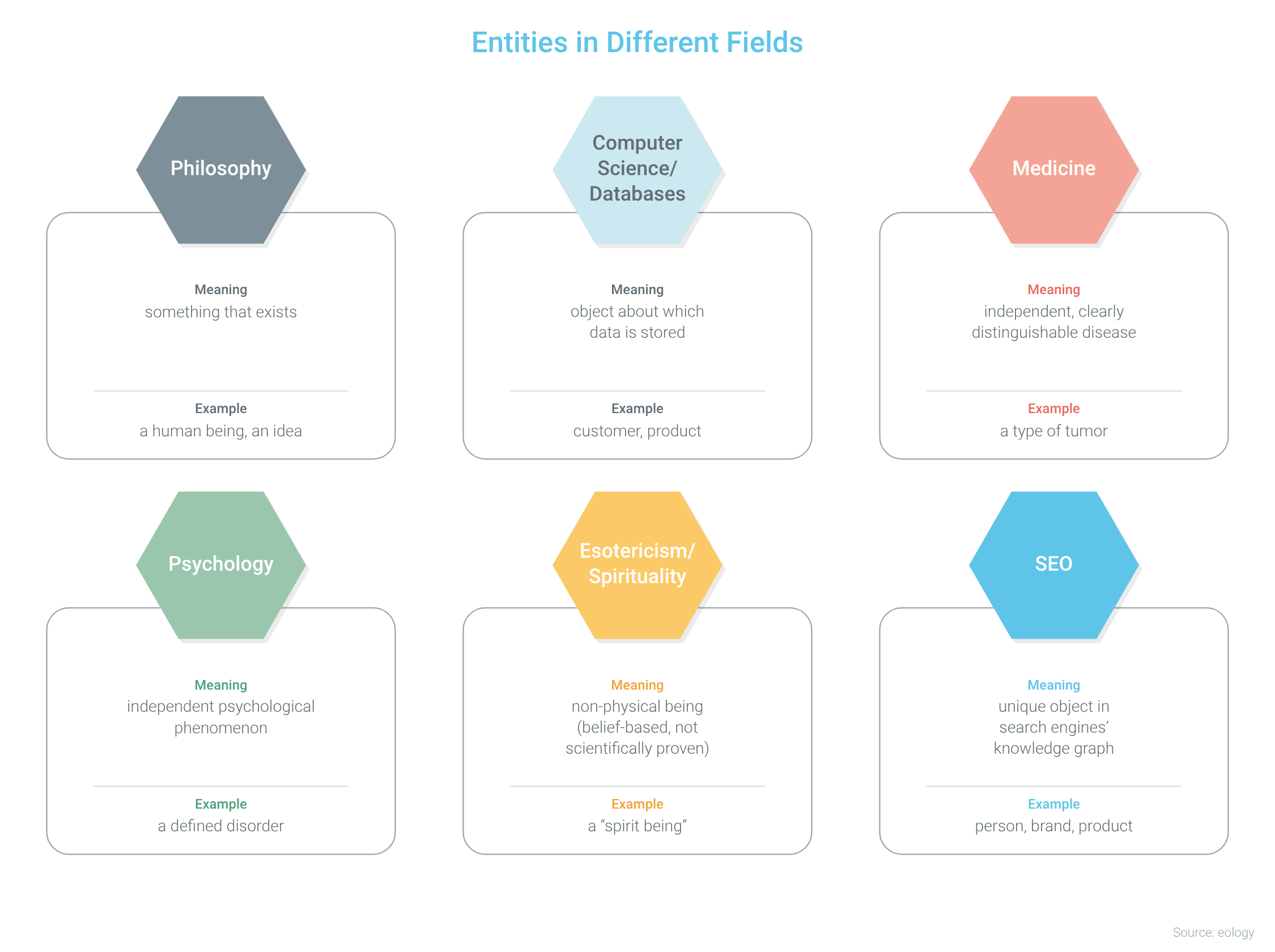
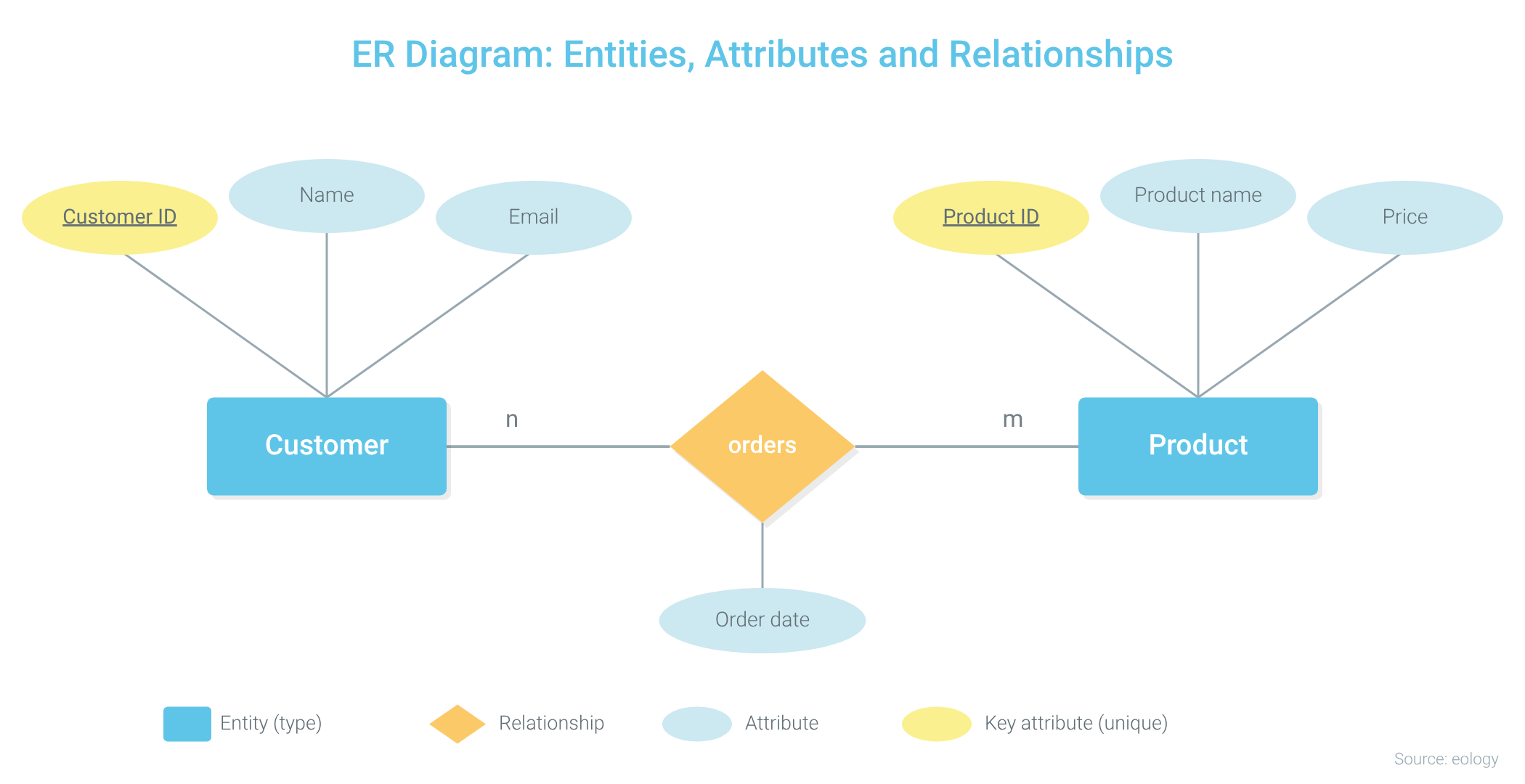
In computer science, entities are the basic building blocks of data modeling. In the entity-relationship model (ER model or entity model), you distinguish between three elements:
This is represented in an ER diagram, from which the tables of a database are later created.
In medicine, an entity or disease entity is an independent, clearly distinguishable clinical condition with typical causes, symptoms or courses. For example, people often speak of tumor entities.
In the past, Google mainly checked whether the words of a search query appeared on a page. But keywords are often ambiguous: “Jaguar” can be a big cat or a car brand. With the Knowledge Graph, Google began in 2012 – under the motto “Things, not strings” – to understand search queries as things rather than strings of characters. You can read more about this in the article on semantic search.
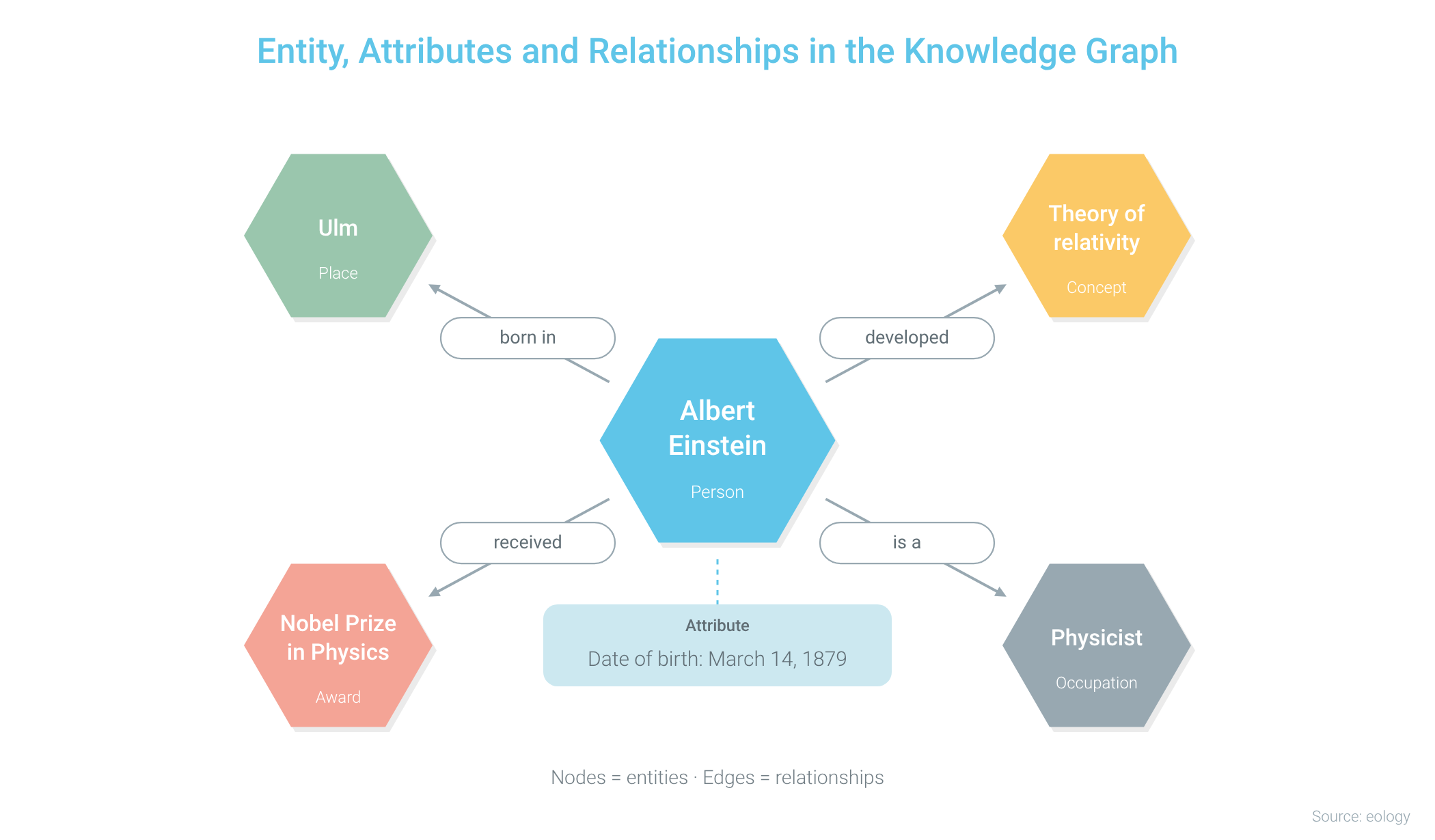
The Knowledge Graph is Google’s knowledge base. According to Google, in 2020 it contained more than 500 billion facts about around five billion entities. Within it, entities are connected through their relationships like a network. This allows Google to answer the question “Where was the inventor of the theory of relativity born?” directly with “Ulm”. This knowledge becomes visible, for example, in the Google Knowledge Panel.
AI systems such as Google’s AI Overviews or ChatGPT also work with entities. If your brand is represented on the web as a clearly defined entity, the chances increase that it will be correctly classified and mentioned in AI answers. Entities are therefore a central building block of Generative Engine Optimization, i.e. optimizing content for AI search systems.
The most common pitfalls are ambiguous brand names and contradictory information in profiles and directories. Clear context and consistent data help here.
What is the difference between an entity and an attribute?
The entity is the object itself, the attribute is one of its properties. The entity “Eiffel Tower”, for example, has the attributes location and height.
What is the difference between a keyword and an entity?
A keyword is the string of characters users type in – often ambiguous. An entity is the unique thing behind it. Keywords show you how people search, entities show you what they search for.
How does my brand become an entity on google?
There is no guarantee. You create good conditions with structured data, consistent company information, a well-maintained Google Business Profile and mentions on trustworthy websites.
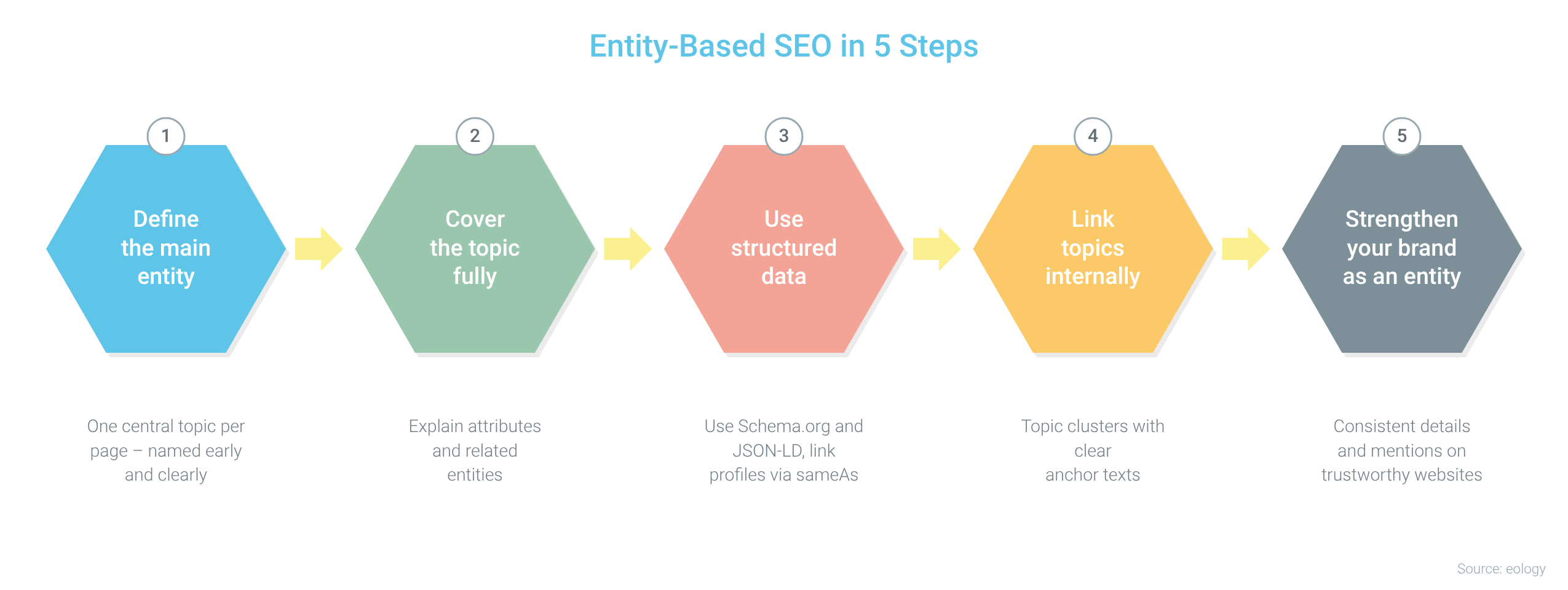
Whether in philosophy, databases or medicine: entities are always uniquely identifiable units with their own identity. In SEO, they ensure that Google and AI systems understand content instead of just matching words. So explain your topics completely and clearly, use structured data and build your brand as an entity. An SEO analysis shows you where your website stands.
The WDF*IDF analysis is an important component for good texts and effective SEO. But how exactly does the formula work and what should be paid attention to? ... Continue readingWDF*IDF
Angular is a powerful framework for the development of single-page web applications (SPAs). Learn more about this here. ... Continue readingAngular
Google CSS stands for Comparison Shopping Service. Behind it lies a clever way to feature your products on Google Shopping while even saving costs. In this article, you’ll learn what Google CSS actually is, how the partner program works, which providers exist, and how you can benefit from it yourself. What many don’t know: Google ... Continue readingGoogle CSS
Want to learn more about exciting topics in the industry?
You are currently viewing a placeholder content from Hubspot Embedded Content. To access the actual content, click the button below. Please note that doing so will share data with third-party providers.
More InformationYou are currently viewing a placeholder content from HubSpot. To access the actual content, click the button below. Please note that doing so will share data with third-party providers.
You are currently viewing a placeholder content from Hubspot Meetings. To access the actual content, click the button below. Please note that doing so will share data with third-party providers.
More Information


