


Relaunch
A relaunch offers you the opportunity to optimize products, logos, websites and brands. Learn more about it here! ... Continue readingRelaunch

Google CSS stands for Comparison Shopping Service. Behind it lies a clever way to feature your products on Google Shopping while even saving costs. In this article, you’ll learn what Google CSS actually is, how the partner program works, which providers exist, and how you can benefit from it yourself.
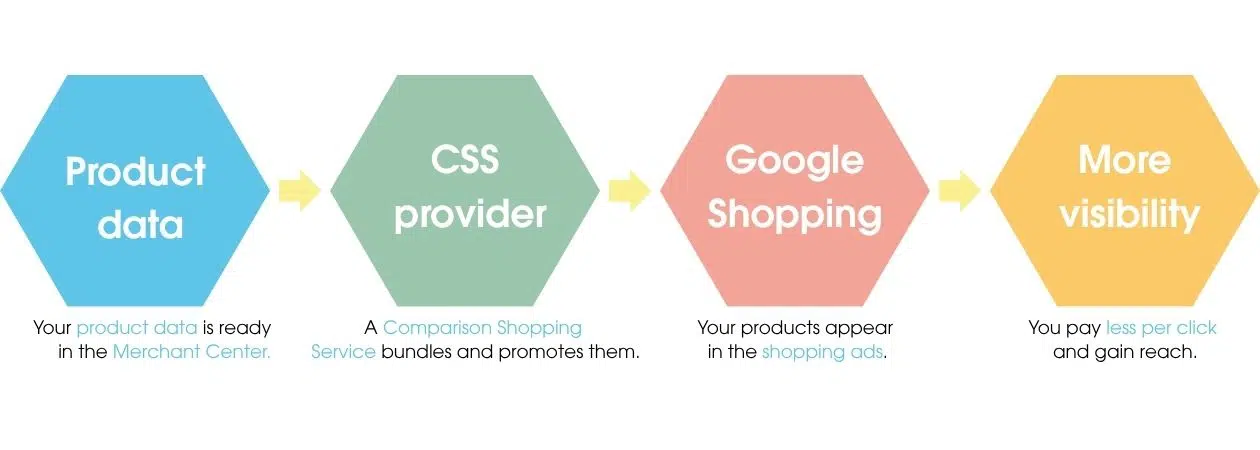
A Comparison Shopping Service (CSS) is a platform through which products are listed, promoted, and ultimately displayed in Google Shopping ads. These comparison shopping services bundle offers from different online retailers and let users quickly and transparently compare prices and conditions directly in the search results.
What many don’t know: Google Shopping is itself a CSS and competes with external comparison shopping portals, known as CSS partners, for the coveted ad placements in Google search. As a retailer, you therefore have the choice of running your shopping ads through Google itself or through an external CSS provider.
Today’s partner program is the result of a decision by the European Commission. In 2017, the EU imposed a record fine of around €2.42 billion on Google because the company had favored its own comparison shopping service over other providers, thereby distorting competition.
As a consequence, Google had to open Google Shopping to external CSS partners. Since then, online retailers have been free to choose which service they use to feature their products in the shopping results, a decisive step toward more fairness and diversity in the ads.
A CSS partner technically connects your online shop with Google Shopping and takes over the key tasks around your campaigns. Instead of running your ads through Google’s standard CSS, they’re booked through the partner’s platform. Typical services include:
The most well-known advantage is cost savings. External CSS partners don’t pay Google a surcharge, which means you can get up to 20% more out of your click price (CPC). Beyond that, you also benefit from:
To see how you can cleverly combine different shopping channels, check out our whitepaper Shopping Ads – Google and Its Alternatives. It gets practical in our webinar on Shopping Ads.
Essentially, there are two options to choose from. On one hand, Google Shopping itself, which is set as the default CSS. On the other hand, a growing number of external CSS providers that specialize in delivering shopping ads, ranging from pure technology providers to full-service agencies.
When choosing, you should pay particular attention to the billing model (fixed fee, percentage-based, or performance-based), the depth of support, and transparency. Some providers work purely on a performance basis, so you only pay when an actual sale happens.
We at eology are also one of these providers and operate our own proprietary CSS, through which we feature your products in Shopping Ads. Having your own CSS is arguably the biggest lever in comparison shopping, as it typically generates more interactions and clicks than a classic third-party provider.
Through our CSS, you get up to 25% more out of your click price (CPC), because the Google surcharge is eliminated. There’s also an often underestimated benefit: the “by CSS” link in your ads generates additional, free traffic to the CSS page. This way, you combine lower costs with maximum visibility in Google Shopping, with no extra effort on your part.
If your click price through Google’s standard CSS is €0.50, it drops by up to 25% to around €0.38 through an external CSS. With 10,000 clicks per month, that saves you over €1,200, budget you can invest directly into more reach and revenue.
Anyone who wants to participate in the program as a comparison shopping portal themselves must meet certain minimum requirements and guidelines from Google. The key points at a glance:
If these criteria are met, the portal can apply via the Google CSS Center and, after successful review, operate as an official partner.
Delivering your product feed via the Merchant Center is free, but you pay per click for the shopping ads themselves. So there’s no fixed fee for being “at the top” on Google, the price results from the auction principle and depends on competition, bid, and the quality of your data. This is exactly where Google CSS comes in: through an external partner, your effective click price drops because the Google surcharge is eliminated. From a purely performance marketing perspective, switching is therefore almost always worth it.
As clear as the benefits are, there are a few pitfalls you should be aware of. For the most common challenges, there’s a simple solution for each:
Google CSS is far more than a technical detail: it’s an efficient lever for running your shopping ads more cost-effectively while increasing your visibility at the same time. Anyone promoting products via Google Shopping should definitely tap into the potential of external CSS partners. With your own CSS like eology’s, you get the most out of it. Pay attention to a transparent billing model, well-maintained product data, and a clear search intent, that way, you turn your shopping channel into a genuine growth driver.
Alina Hahn is passionate about performance marketing and web analytics. With a bachelor's degree in business management specialising in online marketing and a traineeship at eology, she has extensive experience in consulting and implementing tracking tasks and paid ads. Alina loves to work data-driven, which helps companies achieve their marketing goals. Her passion for online marketing inspires her every day to achieve the best results for her clients.
A relaunch offers you the opportunity to optimize products, logos, websites and brands. Learn more about it here! ... Continue readingRelaunch
CMS stands for Content Management System and is a software application that allows webmasters to create websites and manage the content. The content management system is usually installed on a server and then accessed through a browser or mobile device. There are several types of CMS software, such as WordPress, TYPO3, Joomla, Drupal, Magento, Contao, Redaxo, etc. Each of them has its own advantages and disadvantages. ... Continue readingContent Management System (CMS)
Chatbots are computer-based programmes that use artificial intelligence (AI) and machine learning to simulate human communication. Learn more about it. ... Continue readingChatbot
| 06 min |
You want to get more out of your shopping budget?
Get in touch with us!You are currently viewing a placeholder content from Hubspot Embedded Content. To access the actual content, click the button below. Please note that doing so will share data with third-party providers.
More InformationYou are currently viewing a placeholder content from HubSpot. To access the actual content, click the button below. Please note that doing so will share data with third-party providers.
You are currently viewing a placeholder content from Hubspot Meetings. To access the actual content, click the button below. Please note that doing so will share data with third-party providers.
More Information


