The 7 most important content trends for 2026 – data, developments, and specific recommendations for action
Demand for content is growing rapidly and shaping the way brands plan, produce, and deliver their content. According to a recent Adobe study, 71% of marketing executives expect demand for content to at least double by 2027, driven by rising expectations for personalization and demand for new formats such as video and audio. This development creates both challenges and opportunities for content strategies in 2026.
Content Trends 2026 Source: eology
Content marketing will undergo significant changes in 2026. Short videos, AI production, new search habits, and community-oriented formats will determine how companies create, distribute, and measure content. This article provides a detailed overview of the seven most relevant developments.
#Trend 1: Short-form videos are becoming the dominant content format
Short videos are no longer just a trend; they dominate content consumption. Consumers spend an average of around 75 minutes per day watching this video format. The Adobe study also shows that social and short video formats are the fastest-growing content types, with particularly high demand among users and marketing teams alike. According to the Adobe study, 43% of marketers surveyed see growth in social short videos as the strongest driver in the content mix.
Our tips:
Think hook-first: Consistently test the first 3 seconds (question, contrast, strong statement) and regularly replace poor hooks.
Optimize video SEO: Use captions, clear keywords in on-screen text and descriptions, and build playlists and series formats.
Series formats with recognition value: For example, weekly explanatory formats, regular industry updates, or recurring customer interviews.
Short videos should not only be used on social media; they are also suitable as website headers, product teasers, or short learning modules within blog articles.
#Trend 2: AI-supported content creation is becoming standard
Artificial intelligence is no longer a pipe dream in content operations, but standard practice for many brands and agencies. However, most agree that AI tools are helpful, but they cannot replace creative and human thinking. AI support for analysis, content creation, workflow optimization, and trend scouting helps create space for strategic thinking and creative decisions because routine tasks become more efficient.
Our tips:
Build hybrid workflows: Use AI for brainstorming, rough drafts, SEO briefings, variations, and testing—final quality assurance remains with humans.
Use AI data: Systematically evaluate performance data from AI tests (e.g., subject lines, hook variants) and feed learnings back into your content strategy.
Test new tools: Try out automated tools for video production, voice-over creation, layouting, and keyword optimization to increase efficiency and quality. Here, we have tested AI tools for you and summarized our results.
#Trend 3: Trust, proof, and humanity are becoming crucial
While AI delivers effective outputs, the human perspective is becoming increasingly important. Users are increasingly distinguishing between purely algorithmically generated content and content that reflects real people, stories, and experiences. Authentic content builds trust and increases impact on social media and on your own channels alike.
Our tips:
Make experts visible: Consistently include specialists from product, sales, and support in blogs, podcasts, videos, and LinkedIn posts.
Incorporate proof: Integrate figures, studies, customer stories, use cases, and quotes into content in a structured way (preferably directly on the first screen).
Content formats for trust: Expand guides, deep-dive articles, workshops, webinars, and “behind-the-scenes” formats instead of just news and product updates.
The trend is moving away from AI content and back toward genuine human interaction.
Instead of targeting a large audience with a generic content plan, brands that deliver relevant, personalized content to small, clearly defined segments are gaining ground. Users no longer expect just relevant information, but content that is precisely tailored to their situation, behavior, and interests. At the same time, micro-communities are growing – small, highly specialized groups on social platforms that are favored by algorithms and offer brands new opportunities for genuine engagement.
Our tips:
Sharpen segmentation: Split personas by use case, maturity level, industry, or job-to-be-done, and plan content specifically for these clusters.
Utilize community spaces: Build your own groups/channels on LinkedIn, Slack, Discord, or in your own academy and share exclusive content there.
Personalized journeys: Dynamically customize email and onsite content based on behavior (pages visited, downloads, click paths).
#Trend 5: Data ethics, transparency, and compliance in content
In 2026, brand communication will be measured even more strongly against ethical, social, and environmental standards. Content that shows how decisions are made, how processes work, and what values guide a brand will appear more credible and sustainable. Attitude, storytelling, and clear values are essential for providing orientation in the flood of content.
Our tips:
Transparent communication: Disclose where AI is used in the content process and how data is stored and used.
Privacy by design: Develop content and campaign concepts in such a way that they work without invasive third-party tracking (e.g., contextual targeting, newsletter communities).
Integrate legal and marketing: Talk to data protection and legal departments at an early stage to create guidelines that content teams can apply in a practical manner.
With the increased use of AI and first-party data, data protection, transparency, and the ethical handling of user data are becoming central to marketing strategies. This applies not only to tracking, but also to how openly brands communicate about AI use, sources, and data usage.
#Trend 6: Generic content is out
In 2026, it will no longer be the volume of content that counts, but the ability to produce original, data-driven, and contextually relevant content that solves real problems. Brands that want to differentiate themselves must therefore consistently focus on depth, expertise, and recognizability. Your advantage: You can reuse and leverage your high-quality content multiple times—in blogs, on social media, for webinars, or in guest articles.
Our tips:
Define a unique perspective: Clearly define what the brand stands for, what topics it covers, and what tone it uses.
Prioritize added value: Every piece of content should convey at least one concrete solution, one learning point, or one clear stance.
Regularly upgrade content: Update outdated or generic content, expand on it, or replace it with higher-quality formats.
#Trend 7: Content as a sales driver in B2B
B2B marketing is increasingly shifting toward user-centered content and dialogue-oriented communication. According to CMI B2B Content Marketing Trends 2025/2026, 24% of B2B marketers say they will invest significantly more in personalized content experiences in 2026. At the same time, 45% plan to scale their content production with the help of generative AI – but with clear quality and review processes.
Our tips:
Strengthen interactive formats: Tools, checklists, calculation aids, or short self-tests help decision-makers find their bearings more quickly and create direct added value.
Thought leadershipmake visible: Expertise, experience, and clear assessments from experts should be shared regularly in the form of articles, videos, presentations, or LinkedIn posts.
Marketing & sales closer connection: Content should be designed not only to generate attention, but also to answer specific questions in the sales process and support teams in their consulting work.
More and more B2B buying processes are taking place without direct contact with sales—buyers are increasingly informing themselves independently through white papers, studies, videos, toolkits, and community content.
At a glance
What can you do to create and test your content more efficiently? We have summarized some helpful tips that we use ourselves.
Select trends carefully: Only use trends that really fit your brand and connect them with your own topics. Important: Implement the trend promptly; you don’t want to be “too late to the party.”
Standardize prompts: Work with recurring storylines, blog formats, or video structures using fixed prompt templates to ensure consistent output and more efficient workflows.
Show personality: Content has a stronger impact when it is human, approachable, and distinctive. Remember: People speak to people.
Conduct A/B testing: Regularly test reels, hooks, video lengths, or formats to find out what really performs, and let data rather than gut feeling make the decisions.
planning tools: Use editorial plans, content pipelines, and AI-powered structuring tools to facilitate preparatory work and ensure continuous publication.
Companies should consistently focus their content strategy on quality, relevance, and differentiation. Generic content continues to lose its impact – instead, original perspectives, expertise, and clear added value are what count. At the same time, brands need to segment their target groups more strongly and develop content for smaller, specific communities. AI should be firmly integrated into content production and analysis, but always with clear quality standards and human control. Video content, interactive formats, and dialogue-oriented communication continue to gain in importance, as does building and maintaining genuine community relationships.
In short: less mass, more depth. Less push, more dialogue. Less generic, more personalized. Companies that implement this early on will secure significant competitive advantages in 2026.
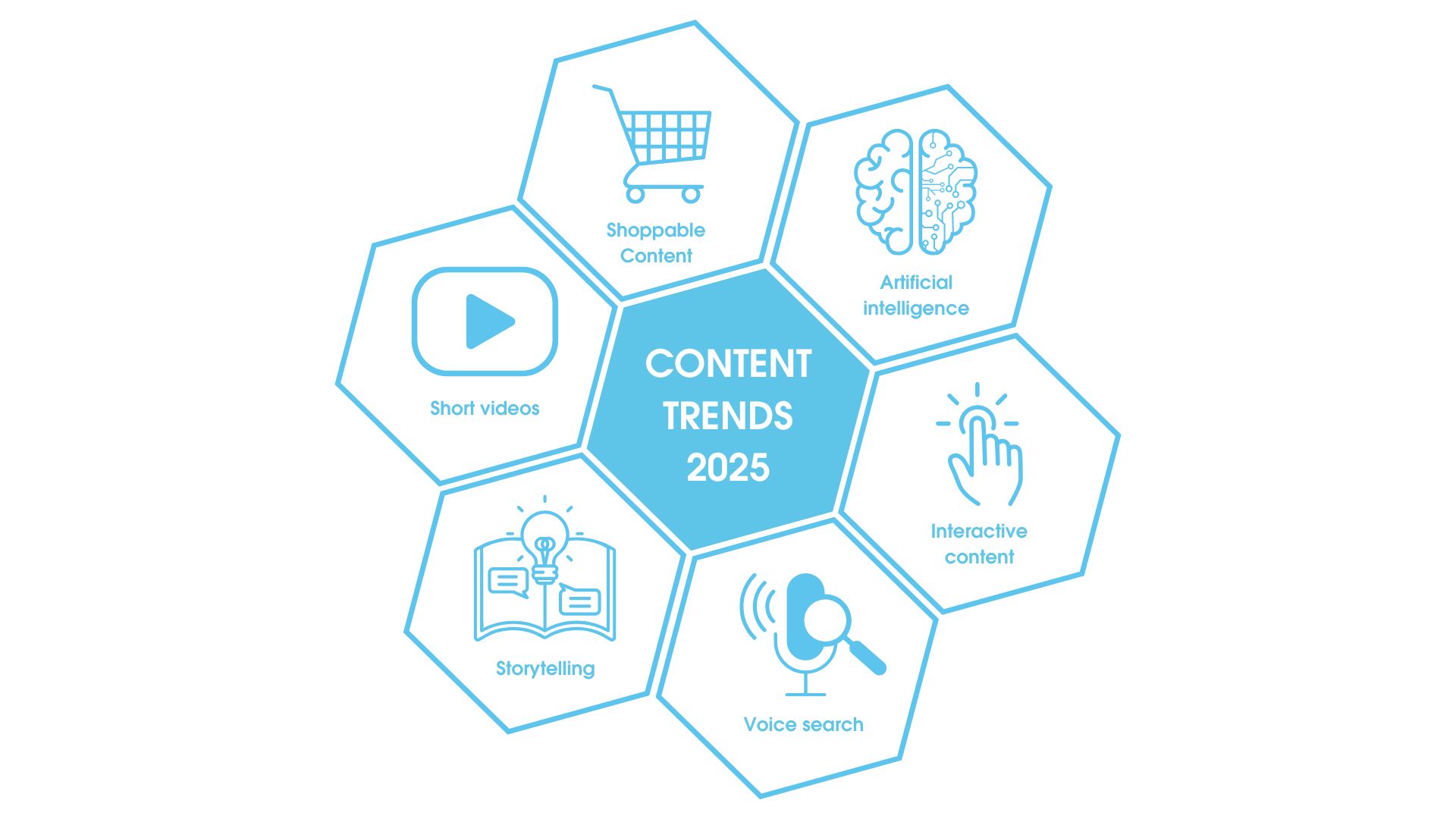
Content trends 2025: These developments will shape marketing
The world of content marketing remains dynamic and requires companies to keep pace with new technologies and strategies. In 2025, clear trends are emerging that will permanently change the way content is produced, presented and consumed.
1. AI-supported content creation: efficiency and precision
Artificial intelligence (AI) is increasingly becoming an indispensable tool in content marketing. From blog articles to social media posts and emails, these technologies not only save time but also make it possible to tailor content specifically to the interests and needs of the target group.
Possible applications:
Automating routine tasks such as creating blog posts or social media posts.
Personalising content in real time based on user data.
Accurately analysing content performance to make optimisations.
2. Short-form videos: snackable in a few seconds
Short-form videos continue to grow in popularity. With platforms like TikTok, Instagram Reels and YouTube Shorts, brands have new opportunities to reach their target groups with short, concise messages. Short videos are particularly suitable for presenting tutorials, product demonstrations or exciting stories in an entertaining way. The advantages are that they are not only more cost-efficient to produce, but also significantly increase reach and engagement rates.
3. Interactive content: actively engage users
Interactive formats such as quizzes, surveys or augmented reality (AR) offer users the opportunity to actively engage with a brand. These experiences not only promote brand loyalty, but also provide companies with valuable data about the behaviour and preferences of their target group.
4. Voice search: The voice becomes a search engine
With the growing popularity of voice assistants such as Alexa and Siri, voice search will account for a large share of online traffic by 2025. Studies show that users use different keywords for voice searches than for classic text searches.
Tips for optimisation:
content should be written in natural and conversational language.
Question and answer formats are particularly effective as they provide direct solutions.
Local optimisation is crucial as many voice searches ask for location-based information.
You can also find more e-commerce trends for 2025 here. 👨🏼💻
5. Authentic storytelling: emotions instead of facts
In 2025, authentic storytelling will be more important than ever. Brands that create emotional connections through stories will stand out from the crowd. Consumers value authenticity, transparency and values that they can share. Consumers are looking for brands that share their values and communicate them credibly. Stories that create emotional connections are more memorable and stand out from the mass of generic content.
6. Shoppable content: Seamless inspiration to purchase
The connection between content and e-commerce is a trend that is changing the way consumers buy products. Whether on Instagram, Pinterest or blogs – shoppable content shortens the customer journey. Instead of inspiration and the purchase decision taking place in separate steps, everything happens in a seamless process. For example, a user discovers an outfit in an Instagram post and can buy it with just one click without leaving the platform. This efficiency increases the conversion rate and improves the shopping experience.
Do you want to assert yourself as a copywriter in the future alongside the use of AI?
That’s why SEO knowledge will be even more important in the future. In our online copywriting certification, you will learn how to successfully create keyword research with tools, what to look out for in metadata, and how to create SEO quality content tailored to your target audience. You can find more information about the certification here. 🧑🎓👨🎓
A look ahead
The content trends for 2025 show that personalisation, interactivity and authenticity are essential to success in digital marketing. One thing remains clear: people – with their values, emotions and stories – continue to be at the heart of a successful strategy.
These are the content trends for 2024!
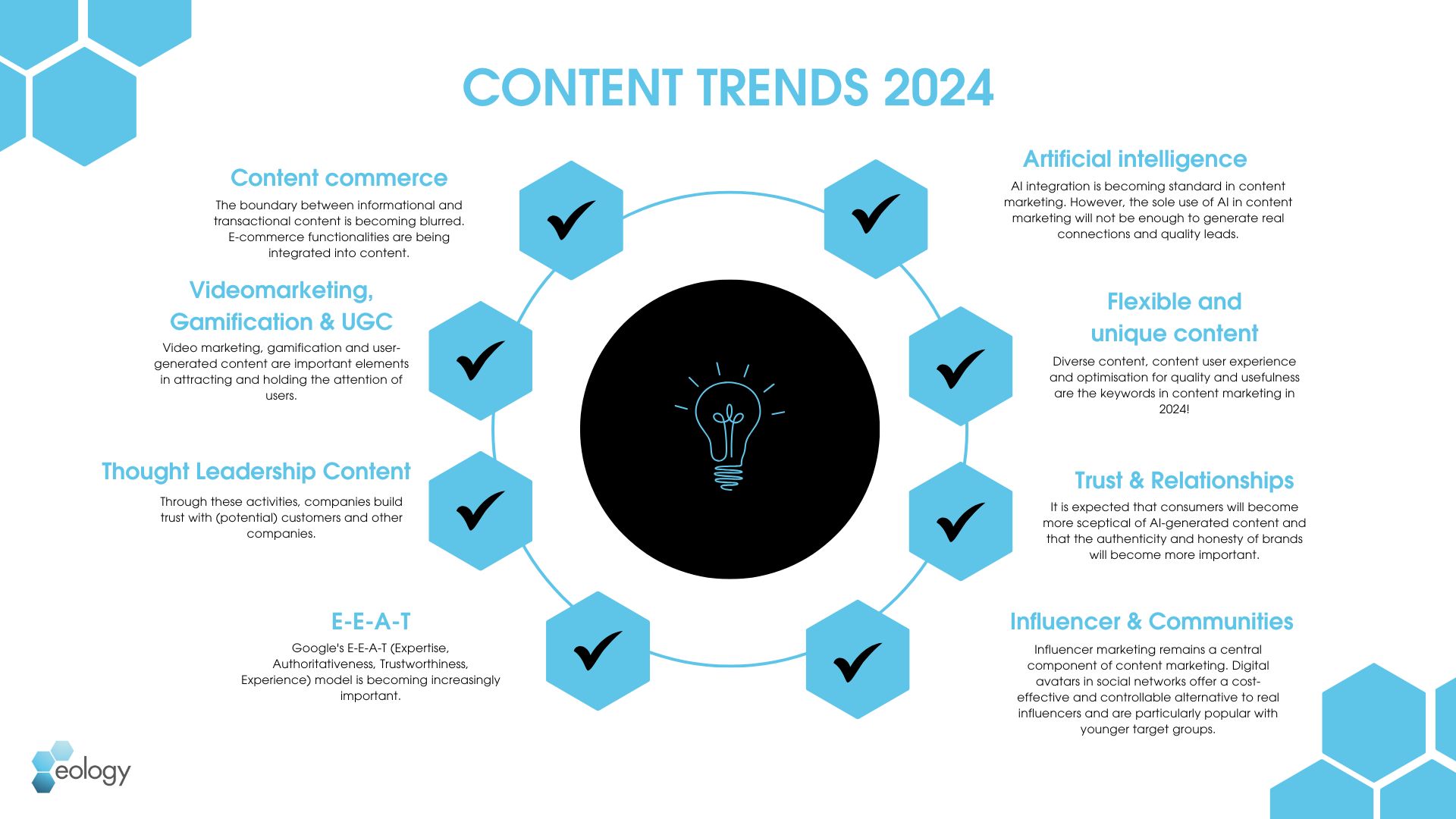
The content marketing trends for 2024 build on the trends of 2023 and show a further developed direction, which is particularly characterised by technological innovations and changing consumer expectations:
AI as a support tool
AI is used as a tool to complement human creativity. AI integration is becoming the standard in content marketing. Around 61% of marketers use AI in their marketing strategies, with 44% using it explicitly for content production. However, AI will not take the lead in content marketing, but rather support human marketers in their creative work. Nevertheless, it should be noted that the use of AI alone is not enough to generate real connections and quality leads in content marketing.
Flexible content for every occasion
Diverse content appeals to the entire target group. Using insights from research to create different content formats is becoming more important. Content marketers plan to increase their investment in blogging and SEO. This will enable them to produce content faster and on a larger scale.
Focus on unique, differentiated content
With the rise of AI tools, marketers need to find new ways to make their content stand out. This involves creating depth and differentiation in content, for example, by using audio or video recordings with experts or customers. The content user experience (UX) is key to holding users’ attention. Content must be modern, entertaining and optimised for digital channels.
Content Commerce – Information and Product in One Go
The line between informational and transactional content is blurring. E-commerce functionalities are being integrated into content to enable direct conversions.
Video Marketing, Gamification and User-Generated Content
Video marketing, gamification and user-generated content (UGC) are important elements in attracting and holding users’ attention.
Videos are a powerful tool for engaging and acquiring customers, as they can convey complex content in a vivid and entertaining way.
Live streams, short video formats such as Instagram Reels, TikToks and YouTube Shorts are gaining popularity because they offer quick, dynamic and authentic insights into brands and products.
Videos make it possible to tell emotional stories, demonstrate products and develop brand personalities, which resonates particularly well with younger target groups such as Generation Z.
Gamification, the integration of game-based elements into marketing campaigns, increases the engagement and interaction of the target group.
Through gamification, brands can create playful challenges, competitions and reward systems that strengthen customer loyalty and positively influence brand perception.
UGC encompasses content created and shared by users and offers authentic insights into the customer experience with a product or service.
UGC is a powerful tool for marketing trust because it comes from real customers and is seen as more credible and trustworthy than traditional advertising content.
UGC allows brands to engage their community, highlight customer feedback, and build a stronger relationship with their audience.
Optimisation for quality and usefulness
Google’s ‘Helpful Content’ update emphasises the importance of high-quality and useful content. Smaller websites that create high-quality content can benefit from these changes.
‘More is more’ no longer applies in content marketing. Google recommends checking content for added value and, if necessary, optimising or deleting it.
Trust and relationship building
It is expected that consumers will become more sceptical of AI-generated content and that the authenticity and honesty of brands will become more important. Marketers should practice radical transparency and communicate honestly with their audience to build trust. Despite the use of AI tools, the human factor remains crucial in content marketing. Authentic and emotionally appealing content will continue to be highly valued.
Growing importance of influencers and private communities
Influencer marketing remains a central component of content marketing, with unique content and collaboration with influencers being crucial to stand out from the crowd. CGI influencers, digital avatars in social networks, offer a cost-effective and controllable alternative to real influencers and are particularly popular with younger target groups.
Double-E-A-T
Google’s E-E-A-T (Expertise, Authoritativeness, Trustworthiness, Experience) model is gaining in importance, with content based on the experiences of users or micro-influencers becoming more and more significant.
Thought leadership content for brand reinforcement
Thought leadership content is playing an increasingly important role in brand reinforcement and content marketing. This trend involves a company’s efforts to establish itself as a ‘subject matter expert’ – a professional who regularly publishes content based on their in-depth expertise. Through these activities, companies build trust with (potential) customers and other companies.
This type of content is presented in a variety of formats, including podcasts, social media posts, studies and videos. It emphasises the expertise of those representing the brand and helps to strengthen brand identity and credibility.
Overall, content marketing in 2024 requires a balance between the use of technology and human creativity, with a focus on authenticity, quality and genuine human connections.
Author
Olga FedukovMarketing Manager
Olga Fedukov completed her studies in Media Management at the University of Applied Sciences Würzburg. In eology's marketing team, she is responsible for the comprehensive promotion of the agency across various channels. Furthermore, she takes charge of planning and coordinating the content section on the website as well as eology's webinars.
ChatGPT & AI chatbots are changing search behavior! While Google continues to dominate, traffic via AI is growing rapidly. Studies show that AI-supported queries are longer and more interactive. Learn more about the differences, effects on link building and off-page SEO, and how they can benefit your SEO strategy! ... Continue readingChatGPT and AI chatbots: influence on search behavior and web traffic
Instagram has been testing the automatic generation of captions in different video formats for some time now. Since May 2021, Instagram users and influencers in selected countries have been able to use the captions sticker in their Stories. Since summer 2021, automatic subtitles for other video formats have also been tested in English-speaking countries. Now, the long-awaited caption feature is also coming for feed videos in German-speaking countries. ... Continue readingAutomatic subtitles for videos: Instagram launches new feature!
Not only FOCUS Growth Champion, but also Top Medium-Sized Employer and winner of the German Agency Award 2022. We are proud of our successes and show how eology achieves them! ... Continue readingTwo more awards for eology
You are currently viewing a placeholder content from Hubspot Embedded Content. To access the actual content, click the button below. Please note that doing so will share data with third-party providers.
You are currently viewing a placeholder content from HubSpot. To access the actual content, click the button below. Please note that doing so will share data with third-party providers.
You are currently viewing a placeholder content from Hubspot Meetings. To access the actual content, click the button below. Please note that doing so will share data with third-party providers.