AI trends in 2026: From hype to practical intelligence
The year 2026 marks a decisive turning point in the development of artificial intelligence. The technology, which was considered futuristic hype just a few years ago, has undergone massive development in recent years and is now an integral part of everyday life and the world of work. Generative AI in particular has taken on a prominent role. From supporting content creation to optimizing business processes, AI is permanently changing the way we work, learn, and communicate. In this article, we’ll show you the most important AI trends for 2026 – technically sound, practical, and with clear relevance for businesses and marketers.
AI Trends 2026 – In a Nutshell!
#Trend 1: More AI agents and autonomous systems in everyday life
A significant trend in 2026 is the transition of AI chatbots from purely reactive systems to genuine proactive agents. These AI systems can not only answer queries, but also perform tasks independently, make decisions, and interact with other systems.
Tools such as ChatGPT, Gemini, and Claude have already begun to develop AI agents that are capable of performing tasks beyond simple conversation. This could range from automating business processes to interactive customer service.
Generative AI is becoming increasingly autonomous in this regard by performing proactive actions and moving toward long-term goals. This means that companies will use AI not only to respond to queries, but also to actively control the next steps in a process—without the need for human intervention.
Why this is important: AI agents create efficiency gains and reduce the workload for employees, but they also serve as the foundation for fully autonomous systems.
#Trend 2: Generative AI becomes an everyday helper
Generative AI has evolved from a purely technological gimmick to a serious tool that supports companies and individuals in a variety of tasks. It is being used more and more, especially in areas such as content creation, research, and even interpersonal communication.
By 2026, a large part of business workflows could be supported by generative AI tools such as ChatGPT or similar systems, particularly in the automation of routine tasks and content generation. The KPMG study shows that 91% of German companies consider generative AI to be important for their business model – 36% more than in the previous year. 69% already have an AI strategy, and 8 out of 10 companies plan to increase their investments in generative AI. The greatest hoped-for benefits lie in innovation and increased efficiency.
But generative AI has also taken a firm place in our private lives. Millions of users now rely on it, whether for creative projects, support in learning processes, or even as a companion in everyday life.
Despite all the progress, challenges such as copyright issues, bias in algorithms, and fear of job losses remain. However, the benefits of AI are too great to ignore. The technology plays a key role, particularly in increasing productivity and knowledge transfer.
Trend 3: Authenticity and humanity in AI
While generative AI increasingly offers the ability to create text, images, videos, and even music, the demand for genuine human authenticity is growing louder. The challenge will be to distinguish AI-generated content from real human experiences.
Especially in creative fields such as marketing, art, and journalism, those who manage to create emotional, authentic connections will stand out from the flood of generic AI content.
Brands that emphasize their authenticity factor are regaining the trust of their target groups. This development is evident not only in content creation, but also in the way companies interact with their customers and communicate their brand values.
TIP:
Want to know how to create authentic and relevant content in 2026? Discover our Content Trends 2026. 💡
Trend #4: AI-supported development of creative content
The creative industries will be increasingly dominated by generative AI in 2026. We are seeing massive changes due to the use of this technology, particularly in the film, music, and gaming industries.
In film production, generative AI will help to shorten production times and reduce production costs. One example of this is the use of AI in the Argentine series El Eternauta, which significantly reduced production costs compared to traditional animation techniques. This trend will continue in 2026 in larger Hollywood productions and TV shows.
AI models are also increasingly being used in gaming to create dynamic storylines and develop realistic, interactive characters that respond to players’ actions in real time. This will not only intensify the gaming experience, but also increase the creativity of developers and open up new possibilities for storytelling and character development.
TIP:
In 2026, generative AI will also grow far beyond text-based responses: Multimodal AI systems combine text, images, speech, and data to enable rich content such as automatic video production, 3D model generation, and interactive audio experiences. This means that creative tasks, marketing content, and product design will continue to be greatly accelerated by AI in 2026—often with higher quality than traditional methods.
Trend #5: Focus on security, compliance, and data sovereignty
Microsoft emphasizes that the increasing use of generative AI is accompanied by a growing awareness of data protection and privacy. The processing of personal data by AI systems poses potential risks that need to be addressed.
In 2026, the focus will increasingly be on privacy-oriented AI models that do not process data centrally, but locally on users’ devices or in their own data centers.
In addition, stronger regulation of AI systems is expected to ensure transparency and ethical guidelines. Companies must ensure that they use AI responsibly and do not jeopardize the trust of their customers.
According to a KPMG study, 62% of German companies want to place greater emphasis on ethical aspects of AI, legal requirements, transparency, and fairness in their AI systems over the next twelve months.
Trend #6: Real-time AI: Edge, 6G, and decentralized intelligence
Future AI applications will no longer take place exclusively in centralized cloud environments.
With advances in edge computing and upcoming network technologies such as 6G, AI systems will become faster, more decentralized, and more context-sensitive. This opens up new scenarios for autonomous vehicles, robotics, and IoT-driven processes.
Trend #7: Generative AI in science and research
Generative AI will play a central role in scientific research in the future by developing hypotheses, controlling scientific experiments, and collaborating with human and AI colleagues. Scientists may soon have an AI lab assistant that not only suggests new experiments but also performs parts of them independently.
This development represents a logical next step based on the principles of technologies such as pair programming in software development, where AI works closely with developers. Just as AI already automates everyday tasks such as shopping or scheduling, it will take on similar tasks in research and offer new opportunities to accelerate discoveries.
This transformation promises to fundamentally change the way scientific breakthroughs are achieved and significantly accelerate the innovation process.
Trend #8: AI as a driver of new job creation
The discussion about job losses due to AI is increasingly being replaced by the creation of new professional fields. Microsoft notes that by 2026, there will be a growing demand for experts who can integrate AI into specialized fields and use the technology responsibly and effectively.
Roles such as prompt engineer, AI model trainer, output auditor, and AI ethics advisor will be in increasing demand in 2026. These professionals are needed to monitor and train AI models and validate their results.
Companies that implement AI agents and automated systems in particular need experts who can coordinate the combination of AI and human workers to maximize productivity while minimizing risks.
AI 2026 – the year of implementation
2026 is the year when artificial intelligence will finally become an indispensable part of our working lives and everyday routines. Trends point to a future in which AI will function not only as a tool, but as an active contributor in almost all areas of society and the economy.
Companies that quickly adapt this technology, optimize their processes with AI, and keep an eye on responsibility and ethical use will be the big winners of this transformation. Those who prepare now for upcoming developments and learn how to use AI correctly can benefit enormously from the huge potential of this technology.
AI trends 2025: is there no future without artificial intelligence?
Artificial intelligence (AI) has developed rapidly in recent years and is increasingly being integrated into all areas of life and work. Even more far-reaching advances are expected by 2025, affecting not only the technology itself but also the way we interact with it. In this article, we take a look at the key AI trends that will shape our world.
AI trends 2025 at a glance
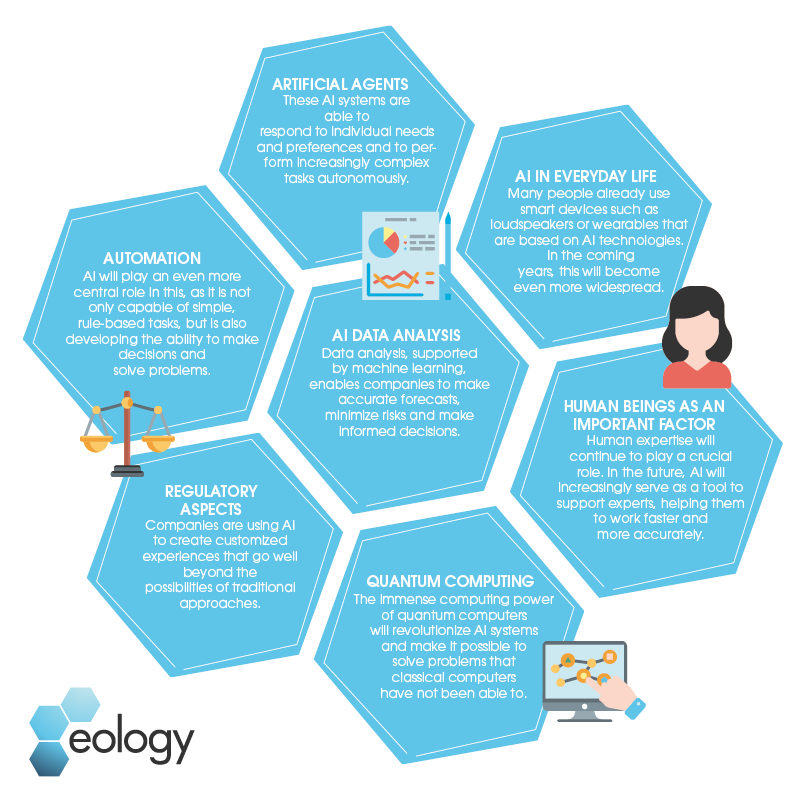
1. Hyper-personalized AI agents
One of the key trends in AI development in the coming years will be the increased use of hyper-personalized AI agents. These AI systems are able to respond to individual needs and preferences and to perform increasingly complex tasks autonomously. These include, for example, personalized learning assistants that respond to the respective progress and preferences of users or virtual assistants that make everyday life more efficient.
These intelligent agents will play a central role in various areas: in healthcare, they can act as virtual doctors offering personalized health advice and in education as customized learning aids. The use of such personalized AI agents could reach a new dimension, particularly in the world of work and in our private lives, through targeted use in various devices and applications.
2. Integration of AI into everyday life
In 2025, AI will be increasingly integrated into our daily lives. Many people already use smart devices such as loudspeakers, thermostats or wearables that are based on AI technologies. However, this integration will become even more profound in the coming years: from intelligent refrigerators that automatically reorder food to virtual reality glasses that display information in real time, AI-controlled systems will increasingly shape our daily lives.
Particular attention is also being paid to the development of so-called “AI-powered assistants”, which not only perform simple tasks such as setting reminders, but can also answer complex queries and make decisions. These devices and applications are designed to support us in our daily organization and act as AI-driven life companions.
3. Advances in AI automation
Another significant trend for 2025 is the increasing use of AI to automate business processes and workflows. Robotic process automation (RPA) has already begun to take over repetitive and time-consuming tasks, such as processing data and performing standard procedures. Artificial intelligence will play an even more central role here, as it is not only capable of performing simple, rule-based tasks, but is also developing the ability to make decisions and solve problems.
This will drastically increase efficiency in various industries, from manufacturing to finance. Particularly in areas such as customer service, accounting and human resources, AI will further reduce manual labor while improving the quality and speed of processes.
4. AI in data analysis
The ability of AI to process and evaluate large amounts of data in real time will be another important trend in 2025. Data analysis, supported by machine learning, enables companies to make accurate forecasts, minimize risks and make informed decisions. Particularly in the area of predictive modeling, AI-supported systems will be able to identify trends at an early stage and provide personalized recommendations.
In practice, this means that companies can better understand their customers and offer tailored products and services. At the same time, the use of AI in business and e-commerce will increase in order to meet the individual needs of consumers and create an optimal user experience.
5. Ethical and regulatory aspects of AI
With the increasing prevalence of AI technologies, there is also a growing need to develop ethical guidelines and regulatory frameworks, such as the EU AI Act. The use of AI systems that intervene in decision-relevant areas such as health, justice and finance requires clear rules to avoid discrimination and sources of error.
In 2025, we therefore expect to see more initiatives for the responsible development of AI. These include both technical solutions to ensure transparency and traceability of AI decisions and legal regulations to protect data privacy and user rights.
6. Quantum computing and AI
Quantum computing is another exciting topic that could significantly influence the development of AI in the coming years. The immense computing power of quantum computers will revolutionize AI systems and make it possible to solve problems that have not been possible with conventional computers up to now. In particular, quantum computing will open new doors in the optimization of algorithms and the analysis of extremely large data sets.
In combination with artificial intelligence, this technology could exceed the performance limits of conventional computers and lead to groundbreaking innovations – in both research and industry.
7. People are an important factor in the use of AI
Despite the rapid development of artificial intelligence, one thing remains clear: human expertise will continue to play a crucial role. AI can analyze large amounts of data, recognize patterns and make decisions based on algorithms, but it remains limited in its creativity, judgment and moral understanding. Humans contribute empathy, ethical considerations and innovative problem-solving approaches that are essential to the success of projects, especially in sensitive areas such as medicine, law or education.
Rather than replacing human labor, AI will increasingly serve as a tool to support experts in the future, helping them to work faster and more accurately. At the same time, there is a growing need for highly trained specialists who are able to develop, monitor and critically question AI systems. The ability to combine technology with human expertise will be key to long-term success.
Interview: How companies are successfully using AI – A look behind the scenes at Lexware
To gain practical insights into the use of artificial intelligence, we interviewed Vanessa Baumann from Lexware. Her answers show how versatile AI can be integrated, but also what challenges arise in the process.
Lexware is a long-standing customer with whom we have already rocked some successful projects. Want to learn more about it? Then check out our case studies. 😉
In which areas are you already using AI technologies and what effects have you been able to achieve as a result?
📷 Image generation
Vanessa: “We use AI to generate images for our articles, especially in our knowledge area or for landing pages. Many of our topics – such as accounting, finance and taxes – are difficult to present visually. In addition, we often had the problem that images from stock platforms had already been used multiple times. Thanks to AI and specific prompts, we can now create unique, individual images.”
Benefits: Saves resources, no need for stock photos, individuality and no duplicate use of images.
📹 Video generation
Vanessa: “For training videos, we use AI avatars based on real instructors from our Lexware Academy. Now that the processes are in place, we are saving a considerable amount of time and effort. The instructors no longer have to travel and the videos can be produced faster – this is especially important for trending topics that arise at short notice and that we want to market as training courses.”
Advantages: consistency, fast production, shorter response time and efficiency.
🔎 SEO
Vanessa: “AI helps us to shorten and rephrase texts, write meta titles and descriptions, and to paraphrase.”
Advantages: speed, more resources in the team, increased efficiency.
💬 Chatbots
Vanessa: “We have integrated chatbots for our users to help them buy products. These ensure a fun experience and guide users quickly and efficiently to the right product – especially helpful for those who don’t like reading long descriptions.”
Benefits: gamification, better user guidance and higher completion rate.
🤖 Support
Vanessa: “We are currently working on an AI-supported chatbot for our support team. This will be trained using existing customer queries and responses. The aim is to relieve the burden on our manual support team while also offering a fast, reliable service.”
What challenges or concerns have you experienced when integrating AI into existing processes?
Vanessa: “A major challenge was designing the processes so that the AI actually works effectively. At first, there were uncertainties as to whether the AI was working properly or spreading misinformation. In addition, the fear that the AI would replace employees caused some concerns.
Another sticking point is compliance with data protection and compliance guidelines. In our company in particular, there are many legal requirements that must be met before AI can even be used. The road to successful integration requires a lot of patience, testing and constant optimization of processes.”
What role do you see for AI in the future and what developments do you expect in the field of online marketing?
Vanessa: “I am convinced that videos will play a central role. Currently, AI-generated videos are often still prone to errors, but I believe that this technology will be greatly optimized and that we will soon be able to use it to produce high-quality content.”
“In general, I still see AI as a support tool, but it is not a replacement for real people. The danger is that some companies rely too heavily on AI and set their expectations too high. One example of this is the uncontrolled production of content that is no longer maintained or checked later – for example, with regard to SEO factors or technical criteria.”
“I expect that legal regulations for AI will be tightened in the future. This will be particularly exciting because companies will then have to think even harder about where and how AI can be meaningfully applied.” – Vanessa Baumann
Artificial intelligence: the key to the future?
In 2025, AI will have become even more important and will have permeated all areas of life. Developments in the field of hyper-personalized agents, automation and data analysis will not only change the way companies operate, but also the way we interact with technology as a society. At the same time, the responsible handling of this technology and ensuring data protection and fairness will play an even more central role.
The question of how we as a society can use AI sensibly and responsibly will be of crucial importance in the years to come. Companies that implement AI technologies early and sustainably will gain a competitive advantage and position themselves as pioneers of the next technological era.
AI trends 2024: technologies that shape our future
The rapid development of artificial intelligence (AI) continues to revolutionize a wide range of industries and aspects of our daily lives. In 2024, significant breakthroughs await us that will further change the way we work, learn and interact. This article highlights the most promising AI trends of the year and shows how these technologies will shape our world.
Small Language Models (SLMs)
At the center of AI development are small language models (SLMs), which, despite being smaller in size compared to large language models (LLMs), demonstrate remarkable capabilities. These models require fewer computational resources, making them ideal for use on mobile devices or in applications where privacy and response speed are crucial. The development of SLMs means that AI technologies are now more widely accessible and applicable in a variety of real-world scenarios, from personal assistants to advanced language translation capabilities.
Multimodal AI systems
Multimodal AI systems, which can understand different types of data such as text (like ChatGPT), images (like DALL-E), audio, and video, are also the focus of innovation in 2024. These systems enable deeper integration and interaction between different digital platforms and end users, resulting in a richer and more seamless user experience. Applications range from advanced search tools that combine visual and text-based information to new forms of creative media production, where AI helps to create personalized content in real time.
Artificial intelligence in online marketing
The integration of AI in online marketing is revolutionizing how companies interact with customers. Artificial intelligence enables a deeper analysis of customer behavior and preferences, resulting in personalized marketing strategies. By using AI, marketers can create dynamic content that adapts in real time to user behavior and interactions. AI also enables automated customer interactions through chatbots that are available 24/7, as well as improved targeting through precise segmentation and forecasting.
Here is an interesting table showing how artificial intelligence can improve various aspects of online marketing:
Functionality
Technology
Marketing benefit
Customer interaction
Chatbots and virtual assistants
Increase in customer engagement and availability.
Content personalization
Recommendation systems
Increase in relevance and engagement through personalized content suggestions.
Data analysis and segmentation
Predictive Analytics
Improve audience segmentation and marketing strategies.
Real-time adjustments
Adaptive learning systems
Optimize campaigns in real time based on user behavior and feedback.
Automated campaign management
AI-powered marketing automation
Increase efficiency by automating repetitive tasks.
SEO
SEO management tools
Improve search engine rankings through optimized keyword use and backlink strategies.
Content Creation
Generative AI models
Automated creation of high-quality, relevant content.
Content Outreach
AI-driven outreach platforms
Automate the distribution and promotion of content across multiple channels.
Brand Marketing
AI-based analysis tools
Strengthening brand perception through targeted marketing campaigns.
Performance Marketing
AI optimization tools
Maximizing ROI through optimized ad spending and strategies.
Social Media Marketing
Social listening tools
Increasing interaction and engagement on social media through data-driven insights.
Tracking
Real-time analysis tools
Tracking and analyzing user actions to continuously optimize campaigns.
Possible applications of AI in online marketing
AI in the workplace
AI in the workplace not only transforms existing occupations, but also creates entirely new job profiles. The automation of routine tasks allows employees to devote themselves to more complex and creative challenges. At the same time, the integration of AI requires an adjustment in work culture and further training of the workforce. The future of work will increasingly be determined by the ability to effectively use new technologies and integrate them into existing processes, which brings both opportunities and challenges.
AI applications in science
Artificial intelligence has the potential to transform science by enabling researchers to innovate faster and find solutions to complex challenges. Particularly in the area of climate change and sustainable agriculture, researchers are developing AI-powered systems that enable more accurate weather forecasting and more efficient farming methods. In medicine, artificial intelligence is accelerating the discovery of new therapies and the development of diagnostic tools, improving the quality of treatment and patient care. These applications are critical to addressing pressing global issues such as pollution, energy scarcity, and health crises.
Personalization through AI
AI’s ability to analyze and learn from vast amounts of data is transforming the personalization of services and products. Companies are using AI to create tailored experiences that go well beyond the capabilities of traditional approaches. From e-commerce sites offering personalized shopping recommendations to streaming services delivering customized content suggestions, companies are using AI to boost customer satisfaction and increase customer loyalty. AI’s advanced analytical capabilities make it possible to recognize and predict individual user preferences and behavior, resulting in ever more precise personalization.
AI in education
The integration of artificial intelligenceinto education promises a revolution in the way educational content is taught and learning success is achieved. AI technologies offer the possibility of creating personalized learning paths that are tailored to the individual needs of students. Platforms like ChatGPT and specialized learning programs are using AI to support teachers and make teaching more efficient. For example, these tools can help monitor students’ progress, provide automated feedback, and tailor learning content based on progress. This not only makes learning more effective, but also more accessible and engaging.
Computer vision – opening up new horizons in industry
Computer vision is a crucial AI trend that is transforming the way industries operate. This technology enables computers to learn and respond to images and videos. In the manufacturing industry, for example, computer vision improves quality control by more accurately detecting defects and streamlining production line monitoring. In medical science, computer vision systems are used to support diagnoses and improve treatment plans. The advances in computer vision offer enormous benefits, including increased efficiency, improved safety and significant cost reductions.
Regulation of artificial intelligence – EU AI Act
The EU AI Act is a comprehensive regulation that aims to standardize the development and application of AI systems in the European Union.
Risk-based classification of AI systems: The AI Act implements a risk-based classification for AI systems that divides them into four categories: unacceptable, high, limited, and minimal risk. Particularly strict regulations apply to AI systems that are classified as “high-risk”. These systems include applications such as biometric identification systems and certain forms of data processing and must meet strict requirements with regard to risk management, data quality, transparency and robustness.
Prohibited and high-risk AI practices: The AI Act explicitly prohibits AI practices that are considered to pose an unacceptable risk. These include techniques that involve manipulative, deceptive or subliminal decision influencing, as well as those based on personal weaknesses such as age or socio-economic status.
Transparency requirements and user rights: The AI Act stipulates that users of AI systems have the right to receive explanations for decisions made by AI systems that affect them. This promotes transparency and enables citizens to file complaints against AI systems.
Impact on existing laws: The AI Act complements existing EU laws, such as data protection and consumer protection, and ensures that compliance with the AI Act does not override existing legal obligations.
The AI Act could thus influence not only the development and application of AI in the EU, but worldwide, as companies operating in the European market would have to comply with the law.llen, die Vorschriften einhalten müssen. Diese Regulierung könnte als globales Modell dienen und ähnlich wie die GDPR (Allgemeine Datenschutzverordnung) einen weitreichenden Einfluss haben.
Artificial intelligence is here and now?
The AI trends for 2024 show a clear shift towards more intelligent, efficient and personalized technologies. They have a profound impact on the economy, education, science and everyday life. Small language models, multimodal systems and advanced personalization techniques are just a few of the developments that will fundamentally change the way we interact with technology. These trends offer both exciting opportunities and significant challenges.
Author
Olga FedukovMarketing Manager
Olga Fedukov completed her studies in Media Management at the University of Applied Sciences Würzburg. In eology's marketing team, she is responsible for the comprehensive promotion of the agency across various channels. Furthermore, she takes charge of planning and coordinating the content section on the website as well as eology's webinars.
That was Campixx 2026. From SEO as a branding task to the real-world benefits of AI in everyday agency work, all the way to specific tool recommendations for Claude and Microsoft Clarity - read all about it here! ... Continue readingeology at Campixx 2026: When SEO becomes brand strategy
You are currently viewing a placeholder content from Hubspot Embedded Content. To access the actual content, click the button below. Please note that doing so will share data with third-party providers.
You are currently viewing a placeholder content from HubSpot. To access the actual content, click the button below. Please note that doing so will share data with third-party providers.
You are currently viewing a placeholder content from Hubspot Meetings. To access the actual content, click the button below. Please note that doing so will share data with third-party providers.